Featured Post

Maintaining Your New California Garden: Life-friendly Fall Pruning

  Mother Nature's Backyard in November: illustrating life-friendly fall pruning. Late fall and early winter are important prun...

Showing posts with label life-friendly gardens. Show all posts

Wednesday, April 25, 2018

Gardening for Health: 3. Time and Anticipation


Goldenstars (Bloomeria crocea) brighten the spring garden.


Gardening for health is more than just exercise doing garden chores.  It’s about designing gardens to help combat the stresses of daily modern life.  The digital era compounds our sense of urgency: there’s something new to worry about every few minutes.  This constant pressure is stressful – it wears us down.  One way that gardens promote health is by taking us out of this toxic environment - at least for a little while.   And there are tricks to make your garden experience even more healthful.

In the natural world, Mother Nature doles out her treats a little at a time.  If you live (or once lived) near a natural area, you know what we mean.  In S. California, the currants and gooseberries surprise with their blooms early in the year.  Lupines enchant with their rain-drenched colors in February and March; they also attract the early flying pollinators, like the bumblebees.  And so on through the seasons. Each month brings special treats to anticipate and keep us coming back. 

A natural place is never quite the same when we revisit it.  Some things stay the same (or nearly so).  But other elements change, month to month and year to year. Mother Nature gets the balance right: enough constancy and enough change.  Too little change is boring; too much can be overwhelming.  Because nature hits the sweet spot we keep returning, both to relax and to see what’s new. Nature is simply irresistible! 


We can adapt nature’s seasonal tricks in planning our gardens.  Most gardens include plants that stay pretty much the same throughout the year.  Evergreen trees and shrubs are good backbone plants because they provide sameness.  The constancy is calming, relaxing and reassuring.  It’s something your family can count on, year after year.     Such enduring views are even more important in an era of rapid change.

But we also need to plan for seasonal ‘treats’; things that give the garden a special allure at certain times of the year.  Among our favorite seasonal elements are the native geophytes (bulbs, corms and rhizomatous perennials).  They are easy to grow and that’s reason enough to use them.  They increase every year and naturalize in the garden – also good traits.

Wild hyacinth (Dichelostemma capitatum)

But native bulbs, corms and rhizomatous perennials also are some of the best ways to add seasonal interest to a garden.  In Mother Nature’s Backyard, we look forward to the emergence of new bulb leaves every winter/spring.  Then we monitor the progress of developing buds over the weeks.  Finally, the flowers emerge – each species according to its season – providing a moment of glorious color (and sometimes scent).   Native geophytes engage, delight and surprise us – every year, year after year.


Native geophytes provide something that’s often lost in contemporary gardens – a sense of time.  They give us a treat to look forward to.  We treasure their ephemeral flowers, knowing that their limited engagement makes them all the more special.  And we know they will return, at the proper time, year after year.  The geophytes provide something rare: that perfect blend of change and constancy that our contemporary world so desperately needs.


So spend a few months learning about the geophytes native to your area.  Think about places where they might succeed in your garden.  Many do well in containers, so even a small garden can utilize them.   Be sure to order your bulbs early (July or August is good – they won’t be shipped until fall).   Then plant a little bit of healthful magic in the form of bulbs and corms.    Trust us, you’ll feel happier – and healthier – for doing so.
 

For more on gardening with native bulbs see:

 
For more posts in this series see: http://mother-natures-backyard.blogspot.com/2018/01/gardening-for-health-1-go-hug-tree-for.html


__________________
 

We welcome your comments (below).  You can also send your questions to: mothernaturesbackyard10@gmail.com


Saturday, January 27, 2018

Gardening for Health: 1. Go Hug a Tree for Health?


No doubt about it – these are challenging times!  Our cities are becoming crowded, sociopolitical alterations are happening all around us and the earth’s climate is changing faster than anyone thought possible.   This tension-producing mélange is served up to us, 24/7, in the news and on social media.  It’s no wonder we’re feeling a little stressed!   In fact, we’re in serious need of stress relievers – and our gardens, parks and local wildlands can play an important role.

Among the important changes (in the last 20 years) is the decreased amount of time spent outside.  Long work hours, longer commutes, urbanization and increased time spent on-line are partly to blame.  So, too, is the decreasing amount of readily available green space in S. California – from true wildlands to informal suburban ‘green spaces’ like vacant lots.   Even when we’re outdoors, we’re more likely to be in an urban setting, with our eyes glued to our mobile devices.

So, why worry about our lack of quality time spent out-of-doors?  Increasing evidence suggests that humans need certain types of outdoor exposures for their physical, mental, creative and spiritual well-being.  That shouldn’t surprise us: humans have spent most of their existence in places very different from modern cities.  Whether in the wilderness, on farms/ranches or in towns of the past, nature was always just a step away.   Connecting with nature was quick and easy.

For most of human history, people were outdoors much of the time: working, walking, playing, gardening, hunting, etc.   Human bodies became well-adapted to an active life out-of-doors.  It’s not surprising that the rapid switch to our modern, indoor life style makes it difficult for our bodies to cope.  The evidence is all around: increased rates of obesity, hypertension, Type 2 diabetes, anxiety, depression and much more.  Human bodies were meant to be active – and to be out-of-doors.

Some nations are way ahead of the U.S. in terms of understanding the importance of nature to urban life.  Some countries even encourage physicians and other healers to prescribe ‘nature activities’ for their patients.  There is a growing body of scientific evidence that supports the effectiveness of such practices.  And if they work, then why not try them here?  Nature activities certainly are more pleasant, less costly – and with fewer side effects - than most medicines.

Over the next few months we’ll be summarizing some of the evidence regarding nature exposure and human well-being.  We’ll also attempt to apply the evidence to the home garden, suggesting ways to make your garden more relaxing, sustaining and healthful.  We’ll also suggest ways that the whole family can interact with gardens, parks and wildlands to increase enjoyment and well-being.   We hope you’ll want to come along for the journey.

If you’re interested in the nature-health connection, we suggest two provocative books on the subject:

Louv, Richard: The Nature Principle: Reconnecting with Life in a Virtual Age. 2012. Algonquin Books of Chapel Hill.  ISBN: 978-1-61620-141-8.

Williams, Florence: The nature Fix: Why Nature Makes Us Happier, Healthier and More Creative. 2017. W.W. Norton Co.  ISBN: 978-0-393-24271-3


More posts in this series:


We welcome your comments (below).  You can also send your questions to: mothernaturesbackyard10@gmail.com

Tuesday, August 15, 2017

Habitat Gardening: Dreams and Realistic Expectations


Habitat gardens provide for butterflies and other creatures

Habitat gardening is becoming popular in the United States and elsewhere.  There’s something satisfying about planting a garden that attracts a wide range of birds and other creatures.  Many gardeners dream of a garden filled with butterflies and birds.  But how realistic is that dream?  And how long will it take for a new garden to meet those expectations?

One thing gardening teaches us is patience.  The best garden features – shade trees, large flowering shrubs, nesting birds – take time.  But you’ll probably see some changes right away, when you begin to garden for habitat.  For example, a water source and fast-growing flowering plants begin attracting insects and birds the first year. 

Native plant gardens change dramatically in the first decade. Here’s what you’ll likely experience, when you convert your S. California garden from conventional garden plants to California native habitat species:

The first year: plants are low and small
Year 1

  • Birds and insects will start coming to a water source almost right away.  Water is scarce, and creatures are skilled at finding it.  Install several water sources to supply this critical resource.
  • Any native that flowers will start attracting some pollinators.  There may not be very many pollinators the first year, but annual wildflowers, perennials and flowering shrubs will see some activity the first year.
  • Any plant that produces seeds will attract some seed-eating birds (like gold finches and white-crowned sparrows) particularly in late summer and fall.  The more annual wildflowers, the more seed eaters you’ll see the first year.


Years 2 and 3: sub-shrubs are larger; annuals still play key role.
Year 2 & 3

  • Flowering perennials, shrubs and sub-shrubs become larger, producing more blooms.  These attract noticeably more insect pollinators and hummingbirds.  We suggest planting annual wildflowers, in open spaces around shrubs, to create still more spring-summer pollinator food. If desired, begin to photograph and document the insect and bird species visiting your garden.
  • As shrubs and trees grow, more use of them as perches and cover by birds and small creatures (lizards).  So you’ll see more of the common birds.
  • More summer-fall, seed-eating migratory birds will pass through, as food sources increase.  They will likely come as small flocks, and won’t stay long.
  • Omnivorous and insect-eating birds occasionally visit; same with dragonflies


Years 4 and 5: even larger shrubs are maturing.
Year 4 & 5

  • As perennials and shrubs mature, noticeably greater numbers and more species of insect pollinators.  May start seeing some rarer native bees, flower flies.  Photograph and document these – you may be surprised!
  • Insects, including butterflies and other pollinators, begin reproducing in the garden, if larval food sources are available.
  • More pollinator moth species (if dusk- and night-bloom plants present)
  • Dragonflies and damselflies start to reproduce in earnest in dragonfly ponds.  You’ll see more adults even without a pond, due to increased insects.
  • Increased numbers of insect-eating insects (Robberflies; predatory wasps).
  • Insect-eating birds increase noticeably.  Watch for Phoebes, Kingbirds, Swifts, Swallows, Flycatchers, Mockingbirds, Bushtits.
  • Established plants provide wild greens and leaves for tea or medicinal use (depending on what species you’ve planted).
  • If you have hummingbird plants, regular visits from Anna’s & Allen’s hummingbirds. 
  • Hummingbirds may begin to nest in larger, dense shrubs & small trees
  • If trees are large and dense, some common birds begin to nest: Northern Mockingbird, House sparrows, House finch.
  • Regular visits from seed-eating finches, other migratory seed-eating birds. White-crowned sparrows and Lesser goldfinch may become regulars.
  • As leaf mulch and seeds build up, visits from ground feeding birds: California towhee, White-crowned sparrow, Doves.
  • Occasional visits from hawks, seeking prey
  • Increased numbers of lizards due to increased insects, cover (unless there are cats, which preclude lizards)
  • As fruiting shrubs and trees begin to produce, begin to see fruit-eating birds: Northern Mockingbirds, Orioles, song birds in winter


Years 6 through 10: As garden matures, more creatures nest in the garden.

Year 6-10

  • Greater diversity of insect pollinators as flowering plants mature.  Most gardens at this stage supply food for literally thousands of individual pollinators. Consider adding plants that attract specialist pollinators: mallows, Annual sunflower, Malacothrix species, Oenothera species.   
  • Greater number of bird species, including those that specialize in insects or fruits.  You may even see flocks of Cedar waxwings, Bushtits, songbirds in fall or winter.
  • Plenty of edible fruits for your family as well (if you’ve planted currants & gooseberries, elderberries, strawberries, wild rose).
  • More birds nest in large shrubs, woody vines and trees; greater diversity of nesting birds, including Bushtits, Northern mockingbirds, Orioles and others (depending on the trees).
  • Consider adding seating in areas with good views of birds, butterflies.  You can do some serious nature observation from this point forward.
  • Regular visits from dragonflies and swallows, phoebes, flycatchers.  The increased numbers of insects are a magnet.
  • Regular nesting of hummingbirds.  Visits from migratory Rufus hummingbird are possible (they are the really feisty, copper-bronze colored guys).
  • More insects, including butterflies and native bees, complete life cycle in the garden (depending on availability of larval food and nest sites).  Consider providing nest sites for ground- and wood-nesting bee species.


Mature garden is a functioning ecosystem.
Year 11 and beyond

  • The garden should be a functioning ecosystem, both above- and below-ground.
  • Many species of pollinators visit and complete their lives in the garden.  Add seasonal flowering plants – or those that attract specialist pollinators – as needed.   Don’t forget the shady areas of the garden.  Some of the shade-loving perennials are great habitat plants.
  • Replace dead plants with new ones that flower and produce fruits or seeds. Choose species you like, including some unusual ones.  Expect some turnover in garden plants – that’s natural.  Fill in open spaces with annual wildflowers until new plants get bigger.
  • There should be birds in the garden most of the time. Birds can be observed conducting all of their usual activities.  The water sources are great places to bird-watch, utilized by both the ‘regulars’ and exotic migrants.
  • Natural leaf mulch/duff supports wide range of creatures, from insects to salamanders, lizards and others.  Take an opportunity to observe this interesting community occasionally.  The duff teams with life!
  • Congratulations!   You continue to create wonderful habitat for creatures who need it.  As green space shrinks – and climate changes stresses wild areas – garden habitat becomes ever more important.  Keep up the good work!


Want to learn more about habitat gardening?   See:


We encourage your comments below.   If you have questions about habitat gardening or other gardening topics you can e-mail us at :  mothernaturesbackyard10@gmail.com

Monday, July 24, 2017

Pollinator Habitat: Does One Small Garden Matter?

Mother Nature's Backyard provides pollinator and bird habitat.

Summer is our peak insect season in Southern California.  And 2017 is a fantastic year for garden insects!  The winter rains have helped a number of species – from butterflies to tiny flower flies – bounce back.  We hope you’re taking the time to enjoy them.
Habitat gardening is gaining popularity throughout the world.  As green space disappears, more gardeners are choosing plants for their habitat value. In doing so, we take it on faith that if we plant the right plants, the insects and other creatures will come.  But how much difference can one small garden really make?  
That’s just the kind of question that biologists like to ask – and try to answer.  To that end, the UC Berkeley Bee Lab (http://www.helpabee.org/) is monitoring bees in gardens throughout the state.  In S. California, they currently have sites in Camarillo, La Canada/Flintridge, Palm Springs and Riverside. We look forward to seeing the results of their monitoring efforts in these gardens.

Several species of native Buckwheats attract summer insects.
Unfortunately, the Berkeley Bee Lab has no sites yet in western Los Angeles County.  That’s a shame – there are many interesting pollinators in our local gardens.  Are the insects different from those of other areas?  Are there (as yet) undiscovered pollinator species in western L.A. County?  What locally native plants are important for the specialist pollinators?  What pollinator species can a small, typical suburban garden support?   All of these are questions begging for answers.

 
Jesus Cepeda, Cal Poly Pomona, examines trap.


And that’s why Mother Nature’s Backyard is currently participating in a study designed to  answer some of those questions – at least for the bees.  Jesus Cepeda, a Master’s Degree Candidate at Cal Poly Pomona, is conducting a study of bee pollinators in six native plant gardens in Los Angeles County.  Most are home gardens; but one is Mother Nature’s Backyard.


Cepeda is a bee biologist.  He wants to know whether native plant gardens attract the same types of native bees as are found in natural areas. He’s also interested in questions of seasonality, floral density and floral species relationships.  And so, about every six weeks, he visits each garden to see what’s flying.
 
Collection in Mother Nature's Backyard
Cepeda uses several collection methods.  He utilizes pan traps (small plastic bowls filled with soapy water) to collect the smaller species.  These are yellow, blue, white and red; he leaves them in place for 24 to 48 hours.  He also uses a net to capture some of the larger species.    He takes them back to the lab, preserves them and determines what species they are.   His results will ultimately be analyzed and published.

We eagerly await the results of Cepeda’s study (we’ll update you when we know more).  Until then, we continue to observe and photograph the insects in our gardens.  Some photos are not so great, but others are detailed enough to classify to the genus or even species level.  We’ve also managed to document some interesting pollinator behavior in our gardens.   All of this just makes us more curious about the creatures with whom we share our gardens.


Cepeda surveys a sunny, July garden
So, does one small garden matter?  The jury is still out, but the hints are promising.  Bigger is better, certainly, but even small gardens are likely to provide important habitat. We suspect that interesting answers – specific to our area - will emerge in the next few years.  The data will help us spread the news about the importance of habitat gardening.  Someday, entire local neighborhoods may provide crucial pollinator habitat.  That’s an exciting thought!

In the meantime, you can help the effort by photographing your garden insects and uploading them to iNaturalist (https://www.inaturalist.org/home).  It’s fun and easy – you may even learn the names of the insects.  And you’ll be doing something no one else can: documenting the insects in your garden for science and for posterity.


Want to learn more about habitat gardening?  See:


We encourage your comments below.   If you have questions about Duskywing butterflies or other gardening topics you can e-mail us at :  mothernaturesbackyard10@gmail.com
 

Saturday, April 29, 2017

Valley Carpenter Bee – Xylocopa varipuncta


Female Valley Carpenter Bee (Xylocopa varipuncta) on California encelia
Mother Nature's Backyard Garden

We love the insects in Mother Nature’s Backyard. In fact, our gardens are specifically designed to attract many types of pollinators, from hummingbirds and bees to moths and flies. But each spring we particularly look forward to the large bees.  Just recently we saw one of our favorites, a female Valley Carpenter Bee (Xylocopa varipuncta).  We thought you might enjoy learning about this interesting native pollinator.  Its scientific name is pronounced: ZIE-low-co-puh  vair-ee-PUNK-tuh).

Valley Carpenter Bee is the largest native bee in California. It belongs to the genus Xylocopa (the Carpenter Bees), a genus with approximately 500 species world-wide.  In general, the Carpenter Bees are large, wood-nesting bees found in a variety of habitats, from the sub-tropics to temperate woodlands. 
 
Female Valley Carpenter Bee (Xylocopa varipuncta) -
busy in spring
 
The Valley Carpenter Bee is native to Southwestern U.S. from California to Texas and south into Northern Baja California, Mexico.   Its common name honors California’s Great Central Valley, where this species does, indeed, occur.  But this bee flies throughout the California Floristic Province (W. of the Sierras) and is fairly common in S. California.   Xylocopa varipuncta lives where ever there is wood for nest-building.  In the wilds, this is most commonly in the lower elevation oak and riparian woodlands of California’s valleys and foothills.  But the species is also seen in urban gardens, particularly those with native plants.

The species Xylocopa varipuncta is the most sexually dimorphic of all the Xylocopa species.  You may have seen the males and females and believed them to be separate species.  Females are large (15-25 mm; ½ to 1 inch), shiny black bees.  They are relatively slow flyers, although they don’t spend long periods on individual flowers.  But if you wait patiently, you can get good pictures of this large bee.

Female Valley Carpenter Bee (Xylocopa varipuncta)
 
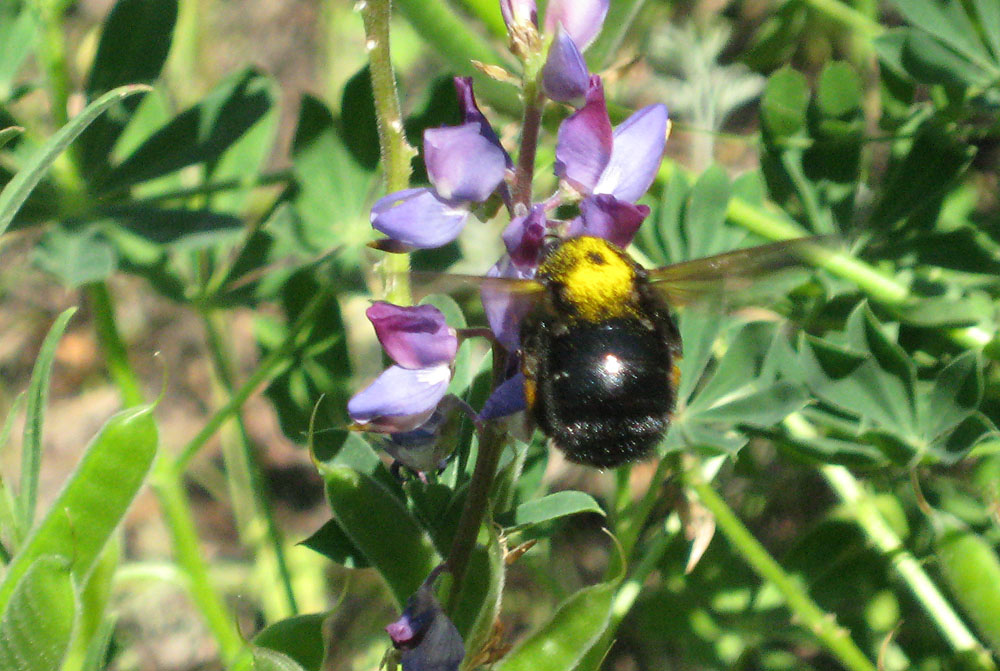
The female Xylocopa varipuncta looks like a large, black bumblebee with amber-colored wings.  The body color is black: black head, thorax, abdomen, legs and antennae.  The female body is shiny, but closer inspection shows that legs, thorax and posterior abdomen are actually quite hairy.  In fact, females can pick up quite a load of pollen, making them look superficially like a black and yellow bumblebee (see below).
 
Female Valley Carpenter Bee (Xylocopa varipuncta) on
 Arroyo Lupine.  Note yellow pollen.
 
Male Valley Carpenter Bees are smaller, very hairy and a striking golden brown color. They also have amazing pale green eyes - there is no other California bee like them.  They are sometimes called ‘Teddy Bear Bees’ because of their resemblance to the childhood toy.  In fact, the males can be aggressive to other bees, but are quite harmless to humans; only the females can sting (and then, usually only when you’re harassing them).


Male Valley Carpenter Bee (Xylocopa varipuncta)


Curious male Valley Carpenter Bee (Xylocopa varipuncta)

The males have been difficult for us to photograph.  They are shy creatures that are almost always in motion. We finally managed to photograph of one (above).  For more good photographs of both males and females, we recommend references 2, 3 and 4, below.

Like all of the Carpenter bees, Xylocopa varipuncta nests in cavities in wood. The females excavate the tunnels with their stout mandibles (jaws), usually choosing softer wood like willow or partly decomposing limbs, stumps or logs.  While not a ‘challenge’ species like the Eastern Carpenter Bees, in urban areas Xylocopa varipuncta sometimes nests in unpainted, untreated wood (like redwood posts).

It takes quite a strong bee to be able to chew through wood!   We recently drilled some ‘starter holes’ in a stump.  A female Carpenter bee has been eyeing them – perhaps she’ll stay?    There are so many places for cavity-dwelling bees to nest in a preserve like the Gardena Willows Wetland Preserve (where our gardens are located). 

Female Valley Carpenter Bee (Xylocopa varipuncta)
 checks potential nest site
 
Valley Carpenter bees overwinter as adults in these tunnels, emerging in the spring (our earliest photos in western Los Angeles County are from early January).  Then the females start to forage and the males start to cruise.  There is much work to be done in spring. First, mating must occur. And then the nesting cavities must be prepared and provisioned, all prior to egg laying.

Valley Carpenter Bees are adaptable.  If hollow-stemmed plants (like bamboo or Elderberry) are available, they create unbranched, linear nests in the stems.  If not, they create or enlarge branched nests in wood.  The branched nests usually contain 6-8 chambers; each will contain a single egg, as well as a supply of ‘bee bread’.  The ‘bee bread’ is a mixture of pollen and nectar made by the female.  It supplies food for the developing bee.

Like everything about Xylocopa varipuncta, their eggs are large (about ½ inch long or a little more; 12-15 mm).  The larvae develop in the nest, emerging as adults in late summer (usually August).   You can often see young adults nectaring in the summer and early fall garden.  The bees hibernate in the nest tunnels over winter, emerging again in the spring or late winter (as early as January in western Los Angeles County).

The mating behavior of Xylocopa varipuncta has been well-studied.  There are many fascinating aspects – more than we can discuss in this short posting.  We refer the interested reader to an excellent Wikipedia posting on the species [ref. 1].

As native plant gardeners, we encounter more insect species than do conventional gardeners.  This is a good thing; it in part explains why native plant gardens tend to be more productive and pest-free than other local gardens.  But, how do we evaluate – and explain to our neighbors – whether a particular insect is a pest or beneficial insect?   We suggest weighing the potential harms against the potential benefits.

The potential harms associated with the Valley Carpenter Bee are two: 1) nesting in wood structures; 2) stings.  Given the choice, Valley Carpenter Bees will choose to nest in dead limbs, trunks, stems and other natural sites, rather than in structural wood [5].  They particularly avoid painted or treated wood.  So, unless you have untreated pine, redwood or cedar, nesting is unlikely to be a problem with our western Carpenter Bees.  You might even want to provide a ‘bee house’ or pieces of logs as suitable alternative nesting places.   And as to the stings, the females are really pretty docile.  They’ll only sting to protect themselves; given the choice, they prefer to avoid you.

As to the services Valley Carpenter Bees provide?  We see at least three: 1) pollination; 2) recycling dead wood; 3) human enjoyment.  The second service is most important in natural settings. In Preserves, parks and other natural areas, cavity-builders help begin the process of breaking down old wood. This is an extremely important service – but not much observed in most gardens. 

Female Valley Carpenter Bee (Xylocopa varipuncta) pollinating
 Tansy phacelia (Phacelia tanacetifolia)
 
Valley Carpenter Bees are important and efficient pollinators.  They can regulate their body temperature [1], allowing them to fly in temperatures both cooler and warmer than other pollinators.  Their hairy bodies allow them to pick up plenty of pollen and transport it to other flowers. They are also capable of ‘buzz pollination’ – literally shaking pollen from the anthers by vibrating their flight muscles.

Studies have shown that Carpenter Bees are more effective pollinators than European Honeybees for such varied plants as Passion vine, cotton, tomatoes and melons.  So we should welcome them into our gardens, and provide them sources of nectar from early spring into fall.


Nectar is the primary source of food and water for adult Xylocopa varipuncta. Obtaining nectar is easy from many flowers.  But some good nectar sources (including Manzanitas, Penstemons and other tubular flowers) present a real challenge for large bees.  Nectar is located deep within the floral tube, accessible only to those small enough or possessing a long tongue. This ensures that only the right creatures – those who actually perform the service of pollination – can access the nectar.
 

Female Valley Carpenter Bee (Xylocopa varipuncta) -
'stealing' nectar from Manzanita
 
The Valley Carpenter gets around this problem by cutting a slit in the floral tube and ‘stealing’ the nectar, without picking up any pollen in the process (see photo above).  These bees even pierce nectar-less flowers, possibly obtaining water, minerals or other chemicals from the plant sap [6].   So yes, these guys can be (adorable) thieves!


And that brings us to the last benefit of Xylocopa varipuncta in the home garden; the enjoyment we get from watching these interesting creatures.  Carpenter bees are large enough for all to observe.  Even the very young and the octogenarian can enjoy their antics.  Many a future biologist has been enthralled by garden bees and other insects. 

In fact, there’s much still to be learned about these bee’s behaviors. That’s the wonderful thing about insects: they’re all around us, yet they remain surprisingly un-studied.  Perhaps you, your child or grandchild, sitting in your garden, will discover something important.  All you need is time, a pair of binoculars (or good eyesight) and a garden that provides for our native pollinators.  What a bargain!


____________________


We encourage your comments below.   If you have questions about Duskywing butterflies or other gardening topics you can e-mail us at :  mothernaturesbackyard10@gmail.com