Featured Post

Maintaining Your New California Garden: Life-friendly Fall Pruning

  Mother Nature's Backyard in November: illustrating life-friendly fall pruning. Late fall and early winter are important prun...

Showing posts with label perennial. Show all posts

Wednesday, September 26, 2018

Plant of the Month (September) : Desert Mock Verbena – Glandularia gooddingii


Desert mock verbena (Glandularia gooddingii) - Mother Nature's Backyard


As Southern California becomes hotter and drier, local gardeners search for plants that will thrive in our changing climate. Increasingly attractive are species from the Sonoran Desert - plants that do well with heat and low rainfall.  Those that grow in washes and intermittent streams can even tolerate the occasional wet winters of western Southern California.  That’s why we’ve advocated certain Sonoran Desert plants in previous postings: http://mother-natures-backyard.blogspot.com/2015/09/sustainable-gardening-trees-for.html

Desert mock verbena is a good example of a desert plant that can transition to a garden setting. In fact, we’ve planted several in Mother Nature’s Backyard this year. While it normally blooms a bit earlier, it’s such a pretty addition we chose it as our Plant of the Month.  You may want to look for it in the fall native plant sales.

Glandularia gooddingii is native to the eastern Mojave and northern Sonoran Deserts from Southwestern Utah and New Mexico south to northern Mexico.   In California, it’s limited to the desert mountains of eastern San Bernardino County.  The common names for this plant reflect its Southwestern desert origins: Southwestern mock vervain; Southwestern vervain; Goodding's verbena; Mojave verbena.  

The scientific name honors Leslie Newton Goodding (1880-1967), a botanist and educator who collected extensively in the American Southwest, particularly in Arizona. [1]    Another well-known native plant that bears his name is the Goodding’s Black Willow (Salix gooddingii).  The scientific name is pronounced: glan-doo-LAIR-ee-uh    good-DING-ee-eye.

Desert mock verbena (Glandularia gooddingii) - growth habit

Desert mock verbena is an herbaceous perennial.  It grows only 1-2 ft. (30 to 60 cm.) tall and 2-3 ft. wide (1 meter).  The overall form of the plant is mounded to spreading.  In fact, the species is often used as a groundcover in suburban desert gardens.  The stems are slender, square and hairy.

Desert mock verbena (Glandularia gooddingii) - foliage
 

The leaves of Glandularia gooddingii are medium green and also softly hairy. Their shape is variable, ranging from lobed to coarsely toothed.  As seen in the photo, above, the leaves often have three lobes that are deeply incised or roughly toothed. The overall effect is lacy green foliage from late winter to early summer.  In the wilds, plants become dormant during the hot, dry summer.   Since our plants are young, we’ve given them a little summer water this year to get them established.  So ours remained green a bit longer.

Desert mock verbena (Glandularia gooddingii) - flower stalks
 

Gardeners like Desert mock verbena for its verbena-like flowers. If you favor the looks of verbena or lantana, this is a native to consider.  In its native setting, Glandularia gooddingii typically blooms from April to June, though it may bloom outside this window depending on summer rains or irrigation.  The flowers are lilac-purple, pale pink or white. Individual flowers are 1/2 inch (1.3 cm) wide, with five petals fused to form a tubular corolla.  Flowers grow in dense clusters on stems above the foliage.  The effect is charming and quite showy; plants will sometimes appear literally covered in blooms.  The flowers attract butterflies and hummingbirds – yet another benefit.

Desert mock verbena (Glandularia gooddingii) - flowers
 

Glandularia gooddingii can be grown in any well-drained soil.  It thrives in full sun to part-shade and needs no fertilizer unless grown in a container.   We suggest planting this species in fall or winter, then giving it winter water if nature doesn’t provide.  Plants look their best with occasional summer water – perhaps every 2-4 weeks from June to August, depending on soil and temperatures.  It’s important to let the soil dry out between waterings; plants can succumb to root rot in all but sandy soils.

Desert mock verbena is a short-lived perennial; perhaps 3-4 years is common.  But if happy, it will reseed on bare ground, keeping you in plants for years to come.  Some gardeners deadhead flowers immediately to lengthen the flowering period.  We advocate waiting to deadhead flower stalks after seeds have spread (or been eaten by birds).  That’s really about all that’s needed in terms of management.  Like most native perennials, plants will die back naturally in fall.

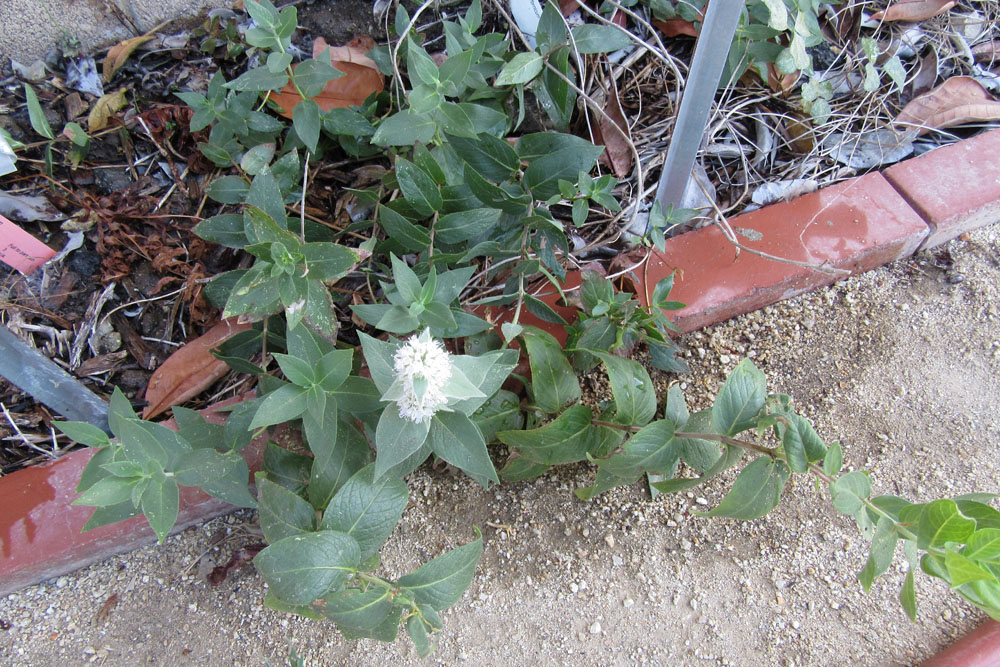
Desert mock verbena (Glandularia gooddingii) - first year
 

Glandularia gooddingii is one of those interesting native perennials that give native gardens their special charm.  It can be massed as a flowering groundcover or grown in a large container or rock garden as an accent. It’s a good companion plant for desert species like Baileya, Larrea, Ambrosia, and Penstemon species. [2]    The unique flowers and foliage also combine well with coastal S. California native shrubs and grasses.  We like to place it along walkways and at the front of flowering beds, where it attracts butterflies and birds.  If you’ve been toying with including some desert natives in your garden, this is a great plant to try. 

Desert mock verbena (Glandularia gooddingii) - young plant

Sunday, August 5, 2018

Plant of the Month (August) : Island alumroot – Heuchera maxima


Island alumroot (Heuchera maxima)
 
Sitting in the shade on a hot summer’s day allows us to really experience our native shade-loving species.  Many are pretty and have unusual foliage, adding to their allure.  One plant that’s been a shade garden staple for many years is the Island alumroot, Heuchera maxima.  The scientific name is most commonly pronounced HER (or HOY)-ker-uh  MAX-im-uh.

The Heucheras are an interesting group of herbaceous perennials in the Saxifrage Family (the Saxifragaceae).  Members of this family generally grow in moist shady places; they are often used similarly in gardens.  Among the California saxifrages are the Boykinias, Heucheras, Jepsonias, Lithophragmas, Micranthas, Suksdorfias, Tellimas and Tolmieas. Of these, the genus with the most species is Heuchera.

The Saxifrages share a number of common features.  Most have rounded or heart-shaped leaves that grow in a mound at the base of the plant (a basal rosette). Most are perennials, dying back to a stout root in winter.  The flowers grow in stalks above the leaves.  Some have medicinal properties, and have been so used.  And most grow in forests or riparian areas, often in shade.

Thirteen species of Heuchera are native to California.  They belong to three groups: those that are primarily coastal, those from far northern California, and those from the mountains (including the Transverse and Laguna Ranges of S. California).  Many Heuchera species have very limited ranges, and several are listed as endangered.   We featured the Seaside alumroot in May: http://mother-natures-backyard.blogspot.com/2018/05/plant-of-month-may-seaside-alumroot.html

Heuchera maxima is one of the coastal species.  It’s native to the Northern Channel Islands, off the coast of Santa Barbara. In the wilds, it grows in moist, shady, north-facing sites, often in canyons or on ocean cliffs.  Island alumroot is a member of the chaparral plant community; it always grows at elevations less than 1500 ft. (500 m.) in nature. Fortunately, it’s available to California gardeners and widely used in gardens in warmer climates (USDA Zones 8-10).


Island alumroot (Heuchera maxima): foliage
 
All the Heucheras have pretty, rounded leaves and Heuchera maxima is no exception. Its leaves are slightly succulent, lobed, with scalloped edges.  The leaf color is green, but may be mottled or two-tone.  The entire plant is slightly hairy.   Leaves have long petioles and are tightly clumped in a basal rosette.  With a little water, the entire plant appears neat and tidy much of the year.

Island alumroot (Heuchera maxima): plant
 
Heuchera maxima begins to bloom in spring and can bloom off-and-on through summer with a little water. The blooms of Island alumroot are small, bell-shaped flowers on slender, upright flowering stems.  The flowers of this species are white to pale pink and are clustered at the tips of side branches on the stem.  The flowers are less densely packed than those of the Seaside alumroot.
Island alumroot (Heuchera maxima): close-up of flowers
 
Several well-known, named Heuchera hybrids share the foliage characteristics of Heuchera maxima and the brighter flowers of the Arizona native Heuchera sanguinea. Hybrids between H. maxima and H. sanguinea range in color from white/pale pink to bright pink or magenta, and are very showy.  Hybrid cultivars include 'Genevieve' (rose-magenta), 'Opal' (white), 'Santa Ana Cardinal' (large red), 'Susanna' (red), and 'Wendy' (pink), all developed at the Rancho Santa Ana Botanic Garden, Claremont CA.  We feature ‘Wendy’ in Mother Nature’s Garden of Health.

Island alumroot (Heuchera maxima): hybrid cultivar 'Wendy'
 
The Heucheras are loved for their ability to tolerate (even need) a shady location.  In nature, this species grows primarily in moist, shady canyons. In the garden it does best with afternoon shade, under trees or on the north side of walls or buildings.  We’ve grown it in clay soils; it can succeed in all but the poorest-draining soils.  It looks good with a yearly application of a light (1/2 strength) fertilizer, particularly in sandy soils.

In dry climates like S. California, Heuchera maxima needs regular irrigation for the first year, until the plant is established.  Then water two to four times a month for best appearance. Plants are actually quite drought tolerant (much more so than the eastern Heucheras) – but they need a little water to look good. We water our alumroots every two weeks from June to August in our clay-loam soils.  Then we taper off water in September.   To conserve water, we recommend using a 1-inch thick organic mulch around Heucheras.  Keep the area under the plants mulch-free to discourage fungal infections of the stems and leaves.

Island alumroot (Heuchera maxima): seed capsules

Heucheras don’t need much in the way of maintenance.  Cut off spent flower stalks for tidiness and to promote a longer bloom season.  Remove old, dead leaves in the fall. If you’ve planted several plants, you may be able to collect seeds from the dry capsules and start some new plants.  And divide plants as needed, usually every 4-5 years. When plants become crowded and blooming decreases, then it’s time to divide.  Division is best done in early spring.

So, why plant Heuchera maxima and its cultivars?   First, these are charming, old-fashioned perennials, with a long history of use in gardens.  Most people have no idea they are California native plants; they look that ‘garden-like’.   Their tidy appearance and low maintenance make them a good choice for many gardens – including front yards.  They look equally appropriate in both traditional and contemporary garden designs.

Island alumroot (Heuchera maxima): Ranch Santa Ana
 Botanic Garden, Claremont CA

Heucheras are the perfect solution for shady parts of the garden. They provide a natural, woodsy element favored by many gardeners.  They can be used as a ground cover (above) or to border shady pathways or flower beds.  With limited water, they can even be used under native oaks.  

Heuchera’s small size makes them a good choice for narrow planting areas.  Heucheras can even be grown in deep containers (they have a tap root) on a shady patio. They are favorites of hummingbirds.  Plant some near a garden bench; you’ll be rewarded by steady visits from these jewels of the air.   The flower stalks also make a pretty addition to floral arrangements.   
 
Island alumroot (Heuchera maxima): good hummingbird plants
 

Finally, Heucheras are known for their medicinal properties.  The leaves and stems – but particularly the roots – produce chemicals that are strongly astringent and possibly anti-microbial.  In traditional medicine, a poultice or extract of the roots was applied to skin wounds and sores to stop the bleeding and reduce swelling.  An extract of the root was used as a gargle for mouth sores and sore throats.   Note: this plant has strong medicinal properties and should not be taken internally.  

In summary, Heuchera maxima is treasured by western gardeners for its attractive foliage, pretty flowers and shade-loving nature.  It’s hard to find an easier-to-grow plant that looks as good as the Island alumroot and its cultivars.  And if you’re creating a Channel Island themed garden, you’ll want to include this species in your collection.  We hope you’ll consider adding this versatile plant to your own garden this winter. 

Heuchera 'Wendy' : Mother Nature's Garden of Health
 

For a gardening information sheet see: http://www.slideshare.net/cvadheim/heuchera-maxima


For plant information sheets on other native plants see: http://nativeplantscsudh.blogspot.com/p/gallery-of-native-plants_17.html


We welcome your comments (below).  You can also send your questions to: mothernaturesbackyard10@gmail.com

Tuesday, September 5, 2017

Plant of the Month (September) : California Mountain (Sierra) Mint – Pycnanthemum californicum


California mountain mint (Pycnanthemum californicum): Mother Nature's Garden of Health


Perennial mints are choice summer plants.  In addition to attracting pollinators, native mints provide wonderful flavors for herbal teas, beverages and desserts.  Blooming in a shady spot in the Garden of Health is one of our favorites, the Mountain mint or Pycnanthemum californicum.   The scientific name is pronounced pick-NAN-the-mum  kal-ee-FOR-nee-kum.

California mountain mint is the only Pycnanthemum native to California. While limited to N. America, most Pycnanthemums grow in places with more summer precipitation than S. California (we’re lucky to have even one species).  The genus is classed in the mint family (Lamiaceae), which includes the California native Lepechinias, Menthas, Monardellas and Salvias.  Like many mints, Mountain mint has pleasantly-scented foliage, traditionally used as both a flavoring and medicinal agent.

Pycnanthemum californicum is commonly known as Mountain mint, Sierra mint, California mint or California mountain mint.  Several other native mints are known as ‘Mountain mint’, so be sure to use the scientific name when purchasing this species.  California mountain mint is endemic to the mountains and foothills of California, including the central and northern Sierras, the Klamath, Modoc and Coastal Ranges of northern California, and southern California’s Transverse and Peninsular Ranges.

In Los Angeles County, it grows in the San Gabriel Mountains and foothills, and is common in the San Antonio Canyon above Claremont and in Lytle Creek Canyon (San Bernardino County).   It always grows in relatively moist sites, in chaparral, oak woodland or pine forest communities, between 1500 and 5500 ft. (500-1500 m.) elevation.

California mountain mint (Pycnanthemum californicum):
 emerging stems in spring
 
California mountain mint is a true perennial.  In our garden it dies back to the ground in fall, emerging again in late winter or early spring.   The emerging stems have the typical appearance of winter-dormant perennial mints (small, compressed leaves on multiple, emerging stems – see above photo).

In many ways, Pycnanthemum californicum is a fairly typical mint. It has square stems, opposite leaves, and flowers in ball-shaped clusters.  The stems are slender and may be upright or draping/sprawling.  Plants add more stems each year and mature plants may become almost shrub-like in appearance.  The stalks can be up to 3 ft. (1 m.) tall, but are rarely more than 12-18 inches in our garden.

California mountain mint (Pycnanthemum californicum):
young foliage (note fine hairs).
 
The leaves are simple, lance-shaped to oval, and up to 1 ½ inches (2-3 cm.) long (or perhaps a little larger in shady conditions). Young leaves are a pale mint green, with mature leaves becoming medium green.  Some leaves – including those with more sun exposure and the younger leaves – are covered with clear, velvet-like hairs.  In the Garden of Health, leaves are slightly shiny and almost hairless at maturity (see below).

California mountain mint (Pycnanthemum californicum):
 mature foliage
 
Unlike the herbaceous Mentha species, the stems of Pycnanthemum californicum are partly woody and wand-like.  The stems are a pale red-brown.  The overall appearance, at least in part-shade, is that of a low perennial groundcover.   The foliage is aromatic, with a unique minty aroma.  The scent is released by touch – a good plant for along walkways, under garden benches or in shadier areas of an herb garden.   It even takes some foot traffic.

California mountain mint (Pycnanthemum californicum):
 flowers
 
Like all mints, the flowers grow in ball-like clusters around the stems. In California mountain mint, the floral masses grow immediately above clusters of small leaves (see above).  The word Pycnanthemum means ‘densely flowered’, a good description for the flowering habit of this genus.  Each flower cluster has 40-50 or more small flowers.  The overall impression is ‘white’, but the flowers merit closer inspection. 

California mountain mint (Pycnanthemum californicum):
close-up of flowers
 
The individual flowers are small (less than 5 mm across), with the characteristic modified flowers of the Mint Family.  The top two petals form a top ‘lip’, which is white and extends forward in this species.  The bottom three petals are fused to form the bottom lip, which may have small purple dots or blotches (see above).  The bottom lobes are fairly elongated in Pycnanthemum californicum and they curve backward at their tips. 

Several pairs of anthers (male sexual organs) extend beyond the lips (also typical for the Mints).  The result is a charming little flower that’s perfectly suited for butterflies, hummingbirds and other native pollinators (including pollinator flies and moths).  Like other Mints, the Pycnanthemums are often planted as shade-tolerant pollinator plants.   They are a good choice, providing nectar in late summer/early fall, when other resources may be limited.

California mountain mint (Pycnanthemum californicum):
works well with native ferns and California bee plant.
 
Pycnanthemum californicum likes some shade, at least in our hot S. California gardens.  We grow ours on the north side of a tall wall, but any place with afternoon shade, bright shade or dappled sun will do.  It can be grown in most soils; it certainly is happy in the clay-loam in our garden.  The only conditions that might not be suited are salty or alkali (pH greater than 8.0) soils.  Mints often do well in somewhat compacted soils, making them useful agents to loosen urban soils.

The California mountain mint does need more water than many local native species.  It can take regular water and will probably be lusher with moister soils.  We give ours a deep soak every other week in hot weather, so the ground dries out between waterings.   It seems to do fine with this regimen, in a clay soil with afternoon shade.  We grow ours with water-loving native ferns, California bee plant (Scrophularia californica), the Heucheras and other perennials with similar shade and water requirements (see above).

California mountain mint (Pycnanthemum californicum):
 shady groundcover with Hoita orbiculata
 
Pycnanthemum californicum is the perfect choice for naturally moist areas of the garden: under splashing fountains, around ponds, near an avian water dripper or mister, etc. It even tolerates seasonal flooding – so an irrigated rain garden or swale is another easy spot.  It would be right at home along the edges of a watered lawn or in a flower bed that gets regular irrigation. 

Mints also do well in containers and Pycnanthemum californicum would be charming in a shady porch pot.  We like it as a filler in a narrow, partly-shady bed between a wall and walkway.  Or grow it as a seasonal ground cover in the shade of a Blue elderberry or other tree.  You might even consider creating some ‘mint beds’ in your herb or vegetable garden.   True foodies can’t have too much mint in a garden!

California mountain mint (Pycnanthemum californicum):
 makes a pleasant tea
 
Which brings us to the useful nature of this charming little mint.  Its unique and lovely flavor has traditionally been used for tea and to flavor beverages, desserts – even meats. The leaves and flowers can be used fresh or dried.  For more on using mints for tea see: http://mother-natures-backyard.blogspot.com/2012/06/making-tea-from-california-native-mint.html.     If you like the flavor, you might want to preserve some for use all year long.  Here are some tips: http://mother-natures-backyard.blogspot.com/2016/04/california-gourmet-making-flavored.html.   

The scent of dried leaves is a lovely addition to potpourri sachets.  The dried leaves even help to deter moths!   To learn about making potpourri from native plants see: http://mother-natures-backyard.blogspot.com/2013/11/garden-crafts-making-potpourri-from.html.  To sooth dry skin, use fresh or dried leaves and flowers as a bath sachet (place in cloth bag; let steep in warm bath water).  You can also use a sachet of dried leaves to freshen laundry (use a sachet bag in the dryer) or to deter moths in closets or linen drawers.


California mountain mint (Pycnanthemum californicum):
 potpourri from dried leaves can be used in many ways.
 
But California mountain mint is more than just a flavoring/aromatic agent. Like most mints, it has a long history of use as a medicinal plant.  The plant makes an astonishing number of plant chemicals, some with known antimicrobial, antifungal and other medicinal properties.  So it’s not surprising to learn that medicinal teas (decoctions) made from Pycnanthemum californicum are used in a number of ways. Because of the many chemicals, mints should not be used by women who are pregnant.

Pycnanthemum tea is a good ‘pick-me-upper’ – a tonic for when you’re feeling a little tired or run down.  The tea is also used for coughs, colds, fever and indigestion.  The combination of antimicrobial, analgesic (pain relieving) and other chemicals probably explain its affects.  A strong decoction was traditionally used as an antiseptic wash for skin wounds, mouth sores and gum disease.  Crushed flowers were placed on a tooth to relieve toothache.   For more on the medicinal uses of this plant see references 1-2, below.

California mountain mint (Pycnanthemum californicum): much to recommend it!
 
In summary, California mountain mint is a summer-fall blooming plant with many useful properties.  It provides nectar and seeds at a time when many natives have gone dormant.  It can be used in places that are shady and which get a little extra water, and can be combined with plants with similar needs (native or not).  And it provides scents, flavors and helpful chemicals – what a bargain in a single plant!  It’s not a showy plant, but it’s a garden star none-the-less.

For a gardening information sheet see: http://www.slideshare.net/cvadheim/pycnanthemum-californicum


For plant information sheets on other native plants see: http://nativeplantscsudh.blogspot.com/p/gallery-of-native-plants_17.html

____________________


We welcome your comments (below).  You can also send your questions to: mothernaturesbackyard10@gmail.com

Saturday, August 5, 2017

Plant of the Month (August) : Dunn’s lobelia – Lobelia dunnii


Dunn's lobelia (Lobelia dunnii var. serrata) - Mother Nature's Backyard 

By August, the only perennials blooming in Mother Nature’s Backyard (other than the buckwheats) are those in moist, shady places.  One pretty little perennial, blooming for the first time this year, is the Dunn’s lobelia.   The scientific name is pronounced low-BEE-lee-uh  DUN-ee-eye  sir-RAY-tuh.

Dunn’s lobelia (sometimes also called Blue lobelia and Rothrock’s lobelia) is a California member of the Campanulaceae, the Bellflower family.  This family has 80+ genera and about 2400 species worldwide, mostly in the Northern Hemisphere [1].  Included are garden favorites like the Campanulas and the Lobelias.  As suggested by the common name, the flowers of the Campanulaceae are bell-shaped and often blue or violet colored.

The genus Lobelia is well-known to gardeners. Ornamental cultivars spread their old-fashioned charm under trees and along shady pathways. They take a little extra water, and so are useful for naturally moist areas.  While some are annuals (or treated that way), perennial species have the added advantage of coming back, year after year, in a welcome splash of green and blue.  No wonder gardeners like the Lobelias.

Only two Lobelia species are California natives.  Both Lobelia cardinalis and Lobelia dunnii are native to the mountains of Central (Santa Barbara and Ventura Counties) and Southern California. They also grow along the Monterrey County coast.  Where ever they are found, they favor shady, moist areas: canyons, seeps, rocky stream banks, the edges of waterfalls – you get the picture. 


There is current debate about the proper taxonomic status of Lobelia dunnii.  Some have proposed reverting to an older taxon, Palmerella debilis, first proposed by the eminent 19th century taxonomist Asa Gray [2]. The California Lobelias do have a distinctive appearance, and may well deserve a genus of their own.  But since most native plant and garden folks know Dunn’s lobelia as Lobelia dunii, we’ll stick with that name for now.

Lobelia dunnii var. serrata, the variety we’ve got in the garden, can still be found in the canyons of the San Gabriel and San Bernardino Ranges, as well as on Santa Catalina Island and in northern Baja California, Mexico.  It was first collected in the 1800’s and grows in moist places in Coastal Sage Scrub and Chaparral below about 4500 ft. (1400 m.).    If you hike the moist canyons below San Antonio (Mt. Baldy) and Ontario Peaks in the San Gabriels, you may have seen it along the streams.


Dunn's lobelia (Lobelia dunnii var. serrata) - in Spring
Like most local perennials, Dunn’s lobelia dies back to the ground in fall, to emerge again with the winter-spring rains. If you continue to water it, the plant will remain green into early fall – then let it dry out and rest.   Most S. California perennials really do need a period of rest in the fall.

Dunn's lobelia (Lobelia dunnii var. serrate): young leaves
If you don’t know what you’re looking for, you may miss the emerging stems (see above).  The emerging leaves look quite different from the leaves of the mature, summer plant.  If a plant is happy, it will send up more sprouts each year, and spreading to a 2-3 ft. patch.   Plants also re-seed in local gardens.

Dunn's lobelia (Lobelia dunnii var. serrate) - foliage
Dunn’s lobelia is an herbaceous perennial, growing at most 12-18 inches (30-45 cm.) tall.   It is sometimes erect, but as likely to be somewhat sprawling (decumbent) of habit.  The leaves are a fresh spring green, elongated and becoming slightly smaller up the stems. The foliage is quite open; not shrubby, but rather a delicate, lacy groundcover, somewhat mint-like in appearance.   

Dunn's lobelia (Lobelia dunnii var. serrata) - flowering stem
The flowers are cottage garden pretty – small and pale lavender or blue. The flowers may be up to 1 inch (2.5 cm) long.  They are clustered at the tops of the stalks. As flowers open over time, the total bloom season may be a month or more.

The petals are fused into a long tube, with 5 lips.  The lower three lips are elongated and extend down.  The upper two lobes are curled tightly back – a unique appearance (see below).  The flowers are loved by long-tongued butterflies; this plant is often planted specifically to attract them.

Dunn's lobelia (Lobelia dunnii var. serrata) - close-up of flowers
Dunn’s lobelia will grow in most local soils (except salty or alkali), though it prefers a rich loam.  It does fine in our local clays.  We’ve been most successful growing this plant on the north side of a tall wall.  It would also do well in dappled sun under trees.  We’d only try it in fall sun at the edges of a pond.

Dunn's lobelia (Lobelia dunnii var. serrata) - delicate perennial
This is a species that likes moist soils - it can even take winter flooding.  Regular water through the bloom season is probably best.  We give ours (in clay) a deep soaking every 3 weeks in summer, then taper off in early September.    That’s really about it.

Lobelia dunnii is a perennial to tuck into shady, moist places.  It does well with native grasses, sedges, juncus, Solanum, Nicotiana and others that like a little extra water.  We’d love to try it in a moist pot on a shady porch. It’s not a garden diva.  But it’s charming as a violet is – simple, sweet and unassuming.  And then there are the butterflies!

In summary, Dunn’s lobelia is a wonderful little perennial.  If you have a moist shady spot – or can create one – this might be a butterfly plant to try.


For a gardening information sheet see: http://www.slideshare.net/cvadheim/lobelia-dunnii


For plant information sheets on other native plants see: http://nativeplantscsudh.blogspot.com/p/gallery-of-native-plants_17.html

________________________

  1. https://en.wikipedia.org/wiki/Campanulaceae
  2. https://www.itis.gov/servlet/SingleRpt/SingleRpt?search_topic=TSN&search_value=845391#null


We welcome your comments (below).  You can also send your questions to: mothernaturesbackyard10@gmail.com