
Featured Post

Maintaining Your New California Garden: Life-friendly Fall Pruning

  Mother Nature's Backyard in November: illustrating life-friendly fall pruning. Late fall and early winter are important prun...

Showing posts with label California native mint. Show all posts

Tuesday, September 5, 2017

Plant of the Month (September) : California Mountain (Sierra) Mint – Pycnanthemum californicum


California mountain mint (Pycnanthemum californicum): Mother Nature's Garden of Health


Perennial mints are choice summer plants.  In addition to attracting pollinators, native mints provide wonderful flavors for herbal teas, beverages and desserts.  Blooming in a shady spot in the Garden of Health is one of our favorites, the Mountain mint or Pycnanthemum californicum.   The scientific name is pronounced pick-NAN-the-mum  kal-ee-FOR-nee-kum.

California mountain mint is the only Pycnanthemum native to California. While limited to N. America, most Pycnanthemums grow in places with more summer precipitation than S. California (we’re lucky to have even one species).  The genus is classed in the mint family (Lamiaceae), which includes the California native Lepechinias, Menthas, Monardellas and Salvias.  Like many mints, Mountain mint has pleasantly-scented foliage, traditionally used as both a flavoring and medicinal agent.

Pycnanthemum californicum is commonly known as Mountain mint, Sierra mint, California mint or California mountain mint.  Several other native mints are known as ‘Mountain mint’, so be sure to use the scientific name when purchasing this species.  California mountain mint is endemic to the mountains and foothills of California, including the central and northern Sierras, the Klamath, Modoc and Coastal Ranges of northern California, and southern California’s Transverse and Peninsular Ranges.

In Los Angeles County, it grows in the San Gabriel Mountains and foothills, and is common in the San Antonio Canyon above Claremont and in Lytle Creek Canyon (San Bernardino County).   It always grows in relatively moist sites, in chaparral, oak woodland or pine forest communities, between 1500 and 5500 ft. (500-1500 m.) elevation.

California mountain mint (Pycnanthemum californicum):
 emerging stems in spring
 
California mountain mint is a true perennial.  In our garden it dies back to the ground in fall, emerging again in late winter or early spring.   The emerging stems have the typical appearance of winter-dormant perennial mints (small, compressed leaves on multiple, emerging stems – see above photo).

In many ways, Pycnanthemum californicum is a fairly typical mint. It has square stems, opposite leaves, and flowers in ball-shaped clusters.  The stems are slender and may be upright or draping/sprawling.  Plants add more stems each year and mature plants may become almost shrub-like in appearance.  The stalks can be up to 3 ft. (1 m.) tall, but are rarely more than 12-18 inches in our garden.

California mountain mint (Pycnanthemum californicum):
young foliage (note fine hairs).
 
The leaves are simple, lance-shaped to oval, and up to 1 ½ inches (2-3 cm.) long (or perhaps a little larger in shady conditions). Young leaves are a pale mint green, with mature leaves becoming medium green.  Some leaves – including those with more sun exposure and the younger leaves – are covered with clear, velvet-like hairs.  In the Garden of Health, leaves are slightly shiny and almost hairless at maturity (see below).

California mountain mint (Pycnanthemum californicum):
 mature foliage
 
Unlike the herbaceous Mentha species, the stems of Pycnanthemum californicum are partly woody and wand-like.  The stems are a pale red-brown.  The overall appearance, at least in part-shade, is that of a low perennial groundcover.   The foliage is aromatic, with a unique minty aroma.  The scent is released by touch – a good plant for along walkways, under garden benches or in shadier areas of an herb garden.   It even takes some foot traffic.

California mountain mint (Pycnanthemum californicum):
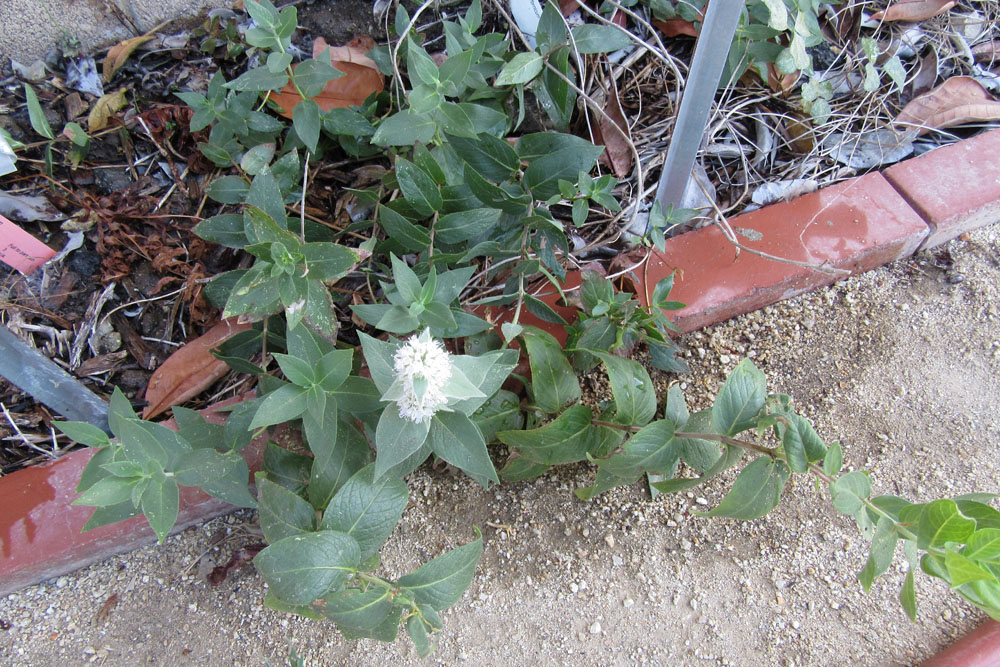
 flowers
 
Like all mints, the flowers grow in ball-like clusters around the stems. In California mountain mint, the floral masses grow immediately above clusters of small leaves (see above).  The word Pycnanthemum means ‘densely flowered’, a good description for the flowering habit of this genus.  Each flower cluster has 40-50 or more small flowers.  The overall impression is ‘white’, but the flowers merit closer inspection. 

California mountain mint (Pycnanthemum californicum):
close-up of flowers
 
The individual flowers are small (less than 5 mm across), with the characteristic modified flowers of the Mint Family.  The top two petals form a top ‘lip’, which is white and extends forward in this species.  The bottom three petals are fused to form the bottom lip, which may have small purple dots or blotches (see above).  The bottom lobes are fairly elongated in Pycnanthemum californicum and they curve backward at their tips. 

Several pairs of anthers (male sexual organs) extend beyond the lips (also typical for the Mints).  The result is a charming little flower that’s perfectly suited for butterflies, hummingbirds and other native pollinators (including pollinator flies and moths).  Like other Mints, the Pycnanthemums are often planted as shade-tolerant pollinator plants.   They are a good choice, providing nectar in late summer/early fall, when other resources may be limited.

California mountain mint (Pycnanthemum californicum):
works well with native ferns and California bee plant.
 
Pycnanthemum californicum likes some shade, at least in our hot S. California gardens.  We grow ours on the north side of a tall wall, but any place with afternoon shade, bright shade or dappled sun will do.  It can be grown in most soils; it certainly is happy in the clay-loam in our garden.  The only conditions that might not be suited are salty or alkali (pH greater than 8.0) soils.  Mints often do well in somewhat compacted soils, making them useful agents to loosen urban soils.

The California mountain mint does need more water than many local native species.  It can take regular water and will probably be lusher with moister soils.  We give ours a deep soak every other week in hot weather, so the ground dries out between waterings.   It seems to do fine with this regimen, in a clay soil with afternoon shade.  We grow ours with water-loving native ferns, California bee plant (Scrophularia californica), the Heucheras and other perennials with similar shade and water requirements (see above).

California mountain mint (Pycnanthemum californicum):
 shady groundcover with Hoita orbiculata
 
Pycnanthemum californicum is the perfect choice for naturally moist areas of the garden: under splashing fountains, around ponds, near an avian water dripper or mister, etc. It even tolerates seasonal flooding – so an irrigated rain garden or swale is another easy spot.  It would be right at home along the edges of a watered lawn or in a flower bed that gets regular irrigation. 

Mints also do well in containers and Pycnanthemum californicum would be charming in a shady porch pot.  We like it as a filler in a narrow, partly-shady bed between a wall and walkway.  Or grow it as a seasonal ground cover in the shade of a Blue elderberry or other tree.  You might even consider creating some ‘mint beds’ in your herb or vegetable garden.   True foodies can’t have too much mint in a garden!

California mountain mint (Pycnanthemum californicum):
 makes a pleasant tea
 
Which brings us to the useful nature of this charming little mint.  Its unique and lovely flavor has traditionally been used for tea and to flavor beverages, desserts – even meats. The leaves and flowers can be used fresh or dried.  For more on using mints for tea see: http://mother-natures-backyard.blogspot.com/2012/06/making-tea-from-california-native-mint.html.     If you like the flavor, you might want to preserve some for use all year long.  Here are some tips: http://mother-natures-backyard.blogspot.com/2016/04/california-gourmet-making-flavored.html.   

The scent of dried leaves is a lovely addition to potpourri sachets.  The dried leaves even help to deter moths!   To learn about making potpourri from native plants see: http://mother-natures-backyard.blogspot.com/2013/11/garden-crafts-making-potpourri-from.html.  To sooth dry skin, use fresh or dried leaves and flowers as a bath sachet (place in cloth bag; let steep in warm bath water).  You can also use a sachet of dried leaves to freshen laundry (use a sachet bag in the dryer) or to deter moths in closets or linen drawers.


California mountain mint (Pycnanthemum californicum):
 potpourri from dried leaves can be used in many ways.
 
But California mountain mint is more than just a flavoring/aromatic agent. Like most mints, it has a long history of use as a medicinal plant.  The plant makes an astonishing number of plant chemicals, some with known antimicrobial, antifungal and other medicinal properties.  So it’s not surprising to learn that medicinal teas (decoctions) made from Pycnanthemum californicum are used in a number of ways. Because of the many chemicals, mints should not be used by women who are pregnant.

Pycnanthemum tea is a good ‘pick-me-upper’ – a tonic for when you’re feeling a little tired or run down.  The tea is also used for coughs, colds, fever and indigestion.  The combination of antimicrobial, analgesic (pain relieving) and other chemicals probably explain its affects.  A strong decoction was traditionally used as an antiseptic wash for skin wounds, mouth sores and gum disease.  Crushed flowers were placed on a tooth to relieve toothache.   For more on the medicinal uses of this plant see references 1-2, below.

California mountain mint (Pycnanthemum californicum): much to recommend it!
 
In summary, California mountain mint is a summer-fall blooming plant with many useful properties.  It provides nectar and seeds at a time when many natives have gone dormant.  It can be used in places that are shady and which get a little extra water, and can be combined with plants with similar needs (native or not).  And it provides scents, flavors and helpful chemicals – what a bargain in a single plant!  It’s not a showy plant, but it’s a garden star none-the-less.

For a gardening information sheet see: http://www.slideshare.net/cvadheim/pycnanthemum-californicum


For plant information sheets on other native plants see: http://nativeplantscsudh.blogspot.com/p/gallery-of-native-plants_17.html

____________________


We welcome your comments (below).  You can also send your questions to: mothernaturesbackyard10@gmail.com

Thursday, July 7, 2016

Plant of the Month (July) : Southern mountain monardella – Monardella australis


Southern mountain monardella (Monardella australis) - Mother Nature's Garden of Health

July is our peak butterfly season, so we like to feature a ‘butterfly plant’ for our July Plant of the Month.  One of the plants that’s causing quite a stir is the Southern mountain monardella (Monardella australis - pronounced ‘mon-ar-DEL-uh  aw-STRAY-lis’).  It’s been blooming up a storm recently in the Garden of Health.

Like many California natives, Southern mountain monardella has engendered some recent taxonomic debate.  Although proposed as a separate species by Leroy Abrams in 1912, it was often classified as a sub-species of the Mountain mondardella, Monardella odoratissima (ssp. australis).  Monardella odoratissima demonstrates variability throughout its wide range (from British Columbia to California and Arizona), and includes several sub-species.  The Southern mountain monardella was thought to be just the S. California variant of a wide wide-ranging plant.  

In 2009 and 2014-15, AC Sanders & RA Elvin argued for species status for Monardella australis and proposed five sub-species. [1] As of now, Southern mountain monardella is accepted as a separate species.  However, Monardella australis can still be found in the nursery trade as Monardella odoratissima ssp. australis, or sometimes just as Monardella odoratissima.   Confusing – but that’s the nature of science!

Southern mountain mint (also known commonly as Southern monardella, Southern coyote mint and Desert mint), grows in the San Gabriel, San Bernardino and San Jacinto Ranges (eastern Transverse Ranges) in Los Angeles, San Bernardino and Riverside Counties of S. California.  It rarely grows below about 4500 ft. (1500 m.) in the wild and can be found as high as 10,000 ft. (3000 m.).   It grows on rocky slopes and forest openings in Yellow pine and Red fir forests.   It perhaps seems an unlikely candidate for lower elevation gardens; and yet it appears to do well there.


Southern mountain monardella (Monardella australis)
 
Southern mountain monardella is a part-woody perennial or small sub-shrub, with a mature size of 1-2 ft. tall by 1-2+ ft. wide (30-60 cm.). Like many local sub-shrubs, it starts out with a few slender, wand-like stems.  As it gets older – and additional branches fill in the shape – it becomes mounded to somewhat sprawling. If you know the San Diego Willowy monardella (Monardella linoides ssp. viminea or Monardella viminea), the shape is somewhat similar.   Our plant in the Garden of Health is young (2 years) and hasn’t yet reached its full potential; it’s still in the gangly, adolescent stage.
 
 
Southern mountain monardella (Monardella australis) - foliage
 
The foliage of Monardella australis is a soft, light- or gray-green.  The leaves are lance-shaped to narrowly ovate, and may be slightly folded in a dry garden (see above).  The margins are entire or sometimes toothed.  The foliage is drought-deciduous; but the plant leafs out again given a little water. 

Both foliage and flowers are highly aromatic.  To our tastes, this is one of the nicest mint flavors among the California natives.  Clean and distinctive, it’s a flavor destined for kitchen and potpourri.  A tea from fresh or dried leaves is refreshing – and can help settle an upset stomach. We’ve used its flavor in cookies, cakes and candies – and gotten rave reviews!    To learn how to make a kitchen extract from this and other mints (oh, so simple!) see: http://mother-natures-backyard.blogspot.com/2016/04/california-gourmet-making-flavored.html
 

Southern mountain monardella (Monardella australis)
 - flowering plant
 
Monardellas are in the Mint family (Lamiaceae).  As expected, their flowers are grouped in ball-like clusters (inflorescences) around the stems.  But the Monardellas are showier of flower than the common culinary mints.  That’s just one reason they have a place of honor in native and traditional gardens, alike.

Southern mountain monardella (Monardella australis) -
 flowers
 

Southern mountain monardella has flowers that range from pale pink to pastel lavender and are hairy.  The bracts at the base of the inflorescence are green and leafy; those surrounding individual flowers are pink-green.   The flowers are about ¾ inch (2 cm) long.  The overall impression is of delicate pastels – like an impressionist painting (possibly Monet?).  This is not the showiest of the native Monardellas – that honor likely goes to Monardella villosa – but the flowers are definitely charming.

Southern mountain monardella (Monardella australis)
 with Gulf Fritillary butterfly
 
Like many in the Mint family, Monardella australis attracts its share of pollinators, including bees (native and European Honeybee), pollinator flies and especially the butterflies. In fact, this species seems to attract both the small (particularly the Skippers) and larger butterflies.  We’ve seen Gulf Fritillary, Western Tiger Swallowtail, the Whites and the Ladies happily nectaring on our Monardella.   If you need an addition to your butterfly garden, this might be the plant.

Monardella australis can be grown in most garden soils.  Though its natural medium is rocky, it seems perfectly happy with sandy soil, clays & clay loams.  As long as your soil drains reasonably, this plant does fine.   It seems to do better with part shade in Western L.A. County, though you can grow it in sun with irrigation.   Even when established, it looks best with occasional summer water; perhaps every several weeks in clays - weekly in sands.  In nature it gets from 1-4 inches of rain in the summer.  So if it’s raining in the local mountains, consider giving your plants a little water.   Taper off watering in late August or September.


Pruning Southern mountain monardella (Monardella australis)


To keep Monardella australis compact and mounded, a yearly pruning is recommended.   Prune each branch back by about 1/3, making sure to leave at least 3-4 sprouting centers.  You can prune in summer or wait until late fall.  Either way, we like to wait until the plant is producing new leaves; that way we know we aren’t pruning back into old, non-productive wood.
 

Southern mountain monardella (Monardella australis)
seedhead ready for harvest
 

If you prune (or deadhead) in summer, you may want to try propagating Monardella australis from seed or stem cuttings.  If propagating from seed, let the seedheads dry on the plant, collect, then separate the tiny seeds from the chaffy bracts (the bracts form tan seed capsules).  Try rubbing the bracts over a metal sieve or piece of screen; the seeds and smaller chaff will fall through.  You can then save the seeds for planting in winter.  Fresh seed should sprout with no pre-treatment.  The seedlings are very small – we’ll try to post some pictures this winter.

We haven’t propagated this plant from cuttings, but will give it a try in a few weeks.  We’ll update this posting with our experiences. 

Southern mountain monardella can be used in several ways in the garden.  It’s sometimes used as a groundcover plant under trees.   If you have an herb garden, that’s another option.  You might also plant it in a dryish, permanent position around the edges of a vegetable garden.  It looks pretty as a foreground plant in mixed beds.  And it would be happy in a large container (at least 18 inches diameter and 24 inches deep).  An unglazed terra cotta pot would work well; and you’ll need to water at least weekly in summer.
 

Umber Skipper (Poanes melane) on Southern mountain
 monardella (Monardella australis)
 

In summary, Monardella australis is a mint that’s unique to our local mountain ranges; it’s truly a part of what makes S. California so special.  It is an excellent butterfly plant and can be planted for this reason alone.  It has a lovely fragrance, making it a choice plant for the herb and kitchen garden.   We hope you can find a place for this little gem in your garden.   Then sit back and enjoy the butterflies!


Fiery Skipper on Southern mountain monardella
 (Monardella australis)


For plant information sheets on other native plants see: http://nativeplantscsudh.blogspot.com/p/gallery-of-native-plants_17.html


We welcome your comments (below).  You can also send your questions to: mothernaturesbackyard10@gmail.com


Monday, April 25, 2016

California Gourmet: Three Cookies Featuring Native Mint Flavors

 
Cookies featuring California native mint.
 
 
We hope our previous post (April 2016) inspired you to make some alcohol extracts of mints from your garden.  These extracts can be used in a wide range of dishes.  In fact, they can be substituted in any recipe calling for mint extract.  Just remember that ‘kitchen extracts’ – particularly those using native mints – are usually milder than the mint or spearmint extract you buy at the store.   You’ll likely need to increase the amount needed; and you’ll just have to experiment to get the right flavor.

We like to use our alcohol extracts in cookies and other baked goods usually flavored with vanilla. These recipes – which commonly use white sugar (or other light-flavored sweetener like Stevia) and no strong spices – are perfect for showcasing the delicate native mint flavors.  Here are three cookie recipes Mother Nature’s Backyard visitors have enjoyed.  Try them and leave your friends and family guessing ‘what flavor are these cookies?’

 
Hint of Hummingbird Sage Cookies: a California mint.
 
We first made this recipe with Hummingbird sage extract – hence the name.  But we’ve found other mints to be equally delicious.  We use small (1 inch) cookie cutters for garden events, tea parties and tastings.  And we like to use flavored sugars as a topper (see below).  You’ll need to flavor and color the sugars ahead of time; but they are an easy way to add a unique, festive touch to these cookies.

The recipe is an adaptation of a great sugar cookie recipe from Maida Heator’s Book of Great Cookies.
 

Hint of Hummingbird Sage Cookies

3 ¼ cups + 2 Tbsp sifted all-purpose flour
2 ½ tsp. baking powder
1 ½ sticks butter (best) or 6 oz. (3/4 cup) margarine; you can use a mixture of butter/margarine
¼ tsp vanilla extract
2 ½ Tbsp Hummingbird Sage extract*
1 ½ cups granulated sugar
2 eggs
Additional granulated, flavored or decorative sugar for topping**

 
Sift together flour & baking powder; set aside.  Cream softened butter or margarine.   Add vanilla, Hummingbird Sage extract and sugar.  Beat well.  Add eggs, one at a time, beating after each egg is added.    Add dry ingredients slowly, scraping bowl to be sure that everything is well mixed. 

Place dough in a wax-paper lined bowl, or divide dough in thirds and wrap each third in waxed paper, plastic wrap or aluminum foil.  Chill dough in refrigerator for at least 3 hours. 

After dough is chilled, preheat oven to 400° F.   Take one third piece of dough, and roll it to the desired thickness on a well-floured pastry cloth.   We like to slightly flatten the dough with our hands and turn the dough once before rolling.  We use a wooden rolling pin with a cloth rolling pin ‘sock’ that has been rolled in flour to keep the dough from sticking.  We roll the dough to 1/8 to ¼ inch thick.  

Cut the dough with cookie cutters.  Carefully transfer the cut-outs to ungreased cookie sheets, placing them about 1 ½ inches apart.    Sprinkle the tops with granulated sugar or colored decorative sugars.  Bake until edges are just lightly tanned – about 8-10 minutes.  Keep a close eye on then – they brown quickly.   Remove from oven.  Transfer cookies to a cooling rack with a large metal spatula (pancake turner).   Let cool.   Enjoy!!

________________

* Use an alcohol extract of Hummingbird sage or any other garden mint whose flavor you like.  For instructions see: http://mother-natures-backyard.blogspot.com/2016/04/california-gourmet-making-flavored.html

** We like to make flavored sugars for a finishing touch.  Place 1 cup of granulated sugar in a jar or plastic container.  Add ¼ cups mint leaves (of the same flavor as the extract), washed, patted dry and coarsely chopped.  Cover and let sit 24 hours, shaking occasionally.  Remove the leaf pieces using a sieve.  Dry the sugar (air dry or in a warm oven) until it no longer clumps.  Store in an airtight jar; use within a month for best flavor.    The sugar can be colored with a few drops of food coloring.  Just add coloring to the jar, then shake until all the sugar is colored.  
 

California Gourmet Icebox Cookies
Flavored with California native mint flavors
 
Icebox cookies are usually called ‘refrigerator cookies’ in modern cookbooks.  But we like the old time name, harkening back to the days when these cookies were cooled in old-fashioned iceboxes.

Icebox cookies are the baker’s dream, particularly when making lots of cookies in a short amount of time.  You make the dough, shape it into rolls, then cool the rolls in the refrigerator for several hours.  Then you slice the dough into thin rounds and bake.  Icebox cookies were the original ‘slice-and-bake’ cookies.

We’ve taken a simple vanilla icebox cookie recipe (found in many cookbooks) and modified it to feature our native mint extracts.  The taste is like a minty shortbread cookie – very nice with tea or coffee, or as dessert.   As always, you may need to modify the amount of extract to suit your taste.
 

California Gourmet Icebox Cookies

1 cup butter or margarine, softened*
1 cup sugar
1 egg
2 Tbsp milk
¼ tsp vanilla extract
2 Tbsp native mint extract**
3 cups all-purpose flour
½ tsp baking soda
4-5 drops food color (if desired)
Colored, flavored sugar (if desired)
 

Place butter/margarine and sugar in a large mixing bowl.  Cream until light, then add egg, milk and extracts.  Beat until light, fluffy and well-mixed.   

Sift together flour and soda.  Add a little at a time to the butter mixture, mixing until well mixed.  Add food coloring (if desired) and mix well. 

Divide dough into four equal parts.  Place each fourth onto a piece of waxed paper.  Form the dough into a long roll (like a log), about 1 inch in diameter.  If desired, you can roll the dough ‘log’ over colored sugar to give a decorative edge.    Roll up each log in the waxed paper, then place on a cookie sheet in the refrigerator.  Chill at least 3-4 hours.
 

California Gourmet Icebox Cookies - ready to bake
 
Take a roll from the refrigerator, remove the waxed paper, then slice into pieces about 1/8 inch thick, placing each slice 1 inch apart on an ungreased cookie sheet.   If desired, sprinkle tops with decorative and/or flavored sugar.  Bake at 375° F (190° C) for 5-8 minutes (or when edges are a light golden brown).  Remove cookie sheet from oven.  Let cool about 1 minute, then remove cookies to a cooling rack. 

Store in an airtight tin or glass cookie jar for up to 2 weeks.  

___________

* We use ½ cup butter & ½ cup margarine or vegetable shortening

** Use an alcohol extract of any garden mint whose flavor you like.  For instructions see: http://mother-natures-backyard.blogspot.com/2016/04/california-gourmet-making-flavored.html


California Meltaway Mint Icebox Cookies.
These cookies are flavored with native mint extracts
 
Here is another icebox cookie recipe that works well with our native mint extracts.  The texture is somewhere between a cookie and a candy – utterly delish!
We modified this recipe from a peppermint cookie recipe posted by The Kitchen McCabe: http://thekitchenmccabe.com/
 

California Meltaway Mint Icebox Cookies

1 ¼ cups butter or margarine (we used ½ butter/1/2 shortening)
½ cup powdered sugar
1 ½ cups all-purpose flour
½ cup cornstarch
¼ tsp vanilla extract
5 tsp. native mint extract*
Food coloring (if desired)
Colored sugar crystals, decorative sugar or flavored sugar**
 

Place the softened butter/margarine and powdered sugar in mixer bowl.  Beat on medium speed 2 minutes, until light and fluffy.  Add extracts and mix in. 

Sift together flour and cornstarch.   Add to butter mixture in several batches and mix until just combined.   Add food coloring if desired and mix in. 

Place dough on a sheet of waxed paper (18-20 inches long).  Form dough into long roll (log) about 1 to 1 ½ inches in diameter.   

Spread colored/flavored sugar on waxed paper.  Roll log in the sugar to coat the outside edges.  Pour off excess sugar (if any). 

Wrap log in waxed paper.  Chill on a cookie sheet in the refrigerator for 1-2 hours. 
 

Slicing California Meltaway Mint Cookies
 
Remove dough from refrigerator.  Unwrap and cut into 1/8-1/4 inch slices.  Place 1 inch apart on ungreased cookie sheet.   Bake at 300° F (150° C) oven for 12-15 minutes.  Bake shorter time for softer cookie; longer for crisper cookie.  Cookies remain white - don’t really brown. 

Remove cookie sheet from oven.  Transfer cookies to a wire rack to cool.   When completely cool, store in an airtight container. 

Makes about 45 cookies.

____________________

* Use an alcohol extract of any garden mint whose flavor you like.  For instructions see: http://mother-natures-backyard.blogspot.com/2016/04/california-gourmet-making-flavored.html

** We like to make flavored sugars for a finishing touch.  Place 1 cup of granulated sugar in a jar or plastic container.  Add ¼ cups mint leaves (of the same flavor as the extract), washed, patted dry and coarsely chopped.  Cover and let sit 24 hours, shaking occasionally.  Remove the leaf pieces using a sieve.  Dry the sugar (air dry or in a warm oven) until it no longer clumps.  Store in an airtight jar; use within a month for best flavor.    The sugar can be colored with a few drops of food coloring.  Just add coloring to the jar, then shake until all the sugar is colored.   

Cookies flavored with extracts made from
 California native mints.
 
We hope you’re inspired to use your new mint extracts in new and creative ways.  These recipes are just a starting place – enjoy! 

____________________________________________________

We encourage you to send us your questions, comments and recipes (either comment below or e-mail to us at : mothernaturesbackyard10@gmail.com