
Featured Post

Maintaining Your New California Garden: Life-friendly Fall Pruning

  Mother Nature's Backyard in November: illustrating life-friendly fall pruning. Late fall and early winter are important prun...

Sunday, September 14, 2014

Seasons in a Southern California Garden


Some people, when moving from a colder climate, are convinced that S. California has no seasons.  Nothing could be further from the truth.  We do have seasons, but they are quite unlike those of Connecticut, Iowa or Colorado.   Once you understand them, you’ll be able to experience them more fully in your own garden.

When you garden with California native plants, each season has its own unique joys, scents, flavors and colors.  Each season also has a series of appropriate garden activities, closely tied to events that happen in nature.  Let’s take a trip through the seasons in several local gardens to see what we mean.

Southern California has a mediterranean climate.  With other areas on the west coasts at around 40° N and S latitude, we experience mild, rainy winters and hot dry summers.  But in fact, our yearly cycle is more subtle.   And it all begins with the cool rains of late fall/early winter. 

The Wet Season


The wet season can begin any time from late October to early December.  Variability in the beginning of the wet season causes headaches for local gardeners who are tired of the dry season want to begin planting.  The variability of California rains is legendary.  Their timing – and amounts – are hard to predict.  But the coming of the rains is always a time of great joy.

 
Our wet season coincides with the coldest part of the year.   The days are short and sunshine can be weak.   Winter deciduous trees and shrubs lose their leaves. 


This is also the time that our native evergreen foliage can be seen to best advantage.  The subtle greens, grays, silvers and whites appear to glow in the muted light.   There’s something magical about the contrasting foliage colors.  The colors of bark are intensified.


The garden at the beginning of the wet season seems flat.  Many of the fall-dormant plants were recently pruned.   But by the middle of this season the shrubs are beginning to leaf out.  They are programmed to do so in the cool, wet weather.


The cool season grasses, which only recently were brown and dormant, suddenly grow with abandon.  Deer and rabbits, if you have them, can be seen at dawn or dusk.


It’s usually too cold for the most troublesome weeds.  But annual wildflowers sprout as soon as the soil is reliably moist.  Be sure you recognize these tiny gems and don’t pull them, mistaking them for weeds.


Dry periods can occur during the wet season.  These can sometimes be prolonged – 2-4 weeks with hot, dry windy conditions.   Check your soil; if it’s dry at a depth of several inches supply some irrigation.

 
Early blooming shrubs provide color in the wet season garden.  Lemonadeberry, California Encelia, the currants, gooseberries and manzanitas are among the most reliable.  Large bees and hummingbirds visit them regularly at the end of the wet season.


The Growth Season


As the days lengthen and temperatures rise, we enter the second season of the year – the growth season.  The growth season usually begins in March in local gardens (although it may be earlier in a dry year).   Available soil moisture, warm days, plenty of sunshine and an explosion of growth in the garden – that’s the growth season.


Weeds and wildflowers, their seeds spread by dry season winds, are sprouting everywhere.  Be sure to pull them out where not wanted.  Spray a little vinegar on weeds/wildflowers growing between bricks and pavers – it works wonders.
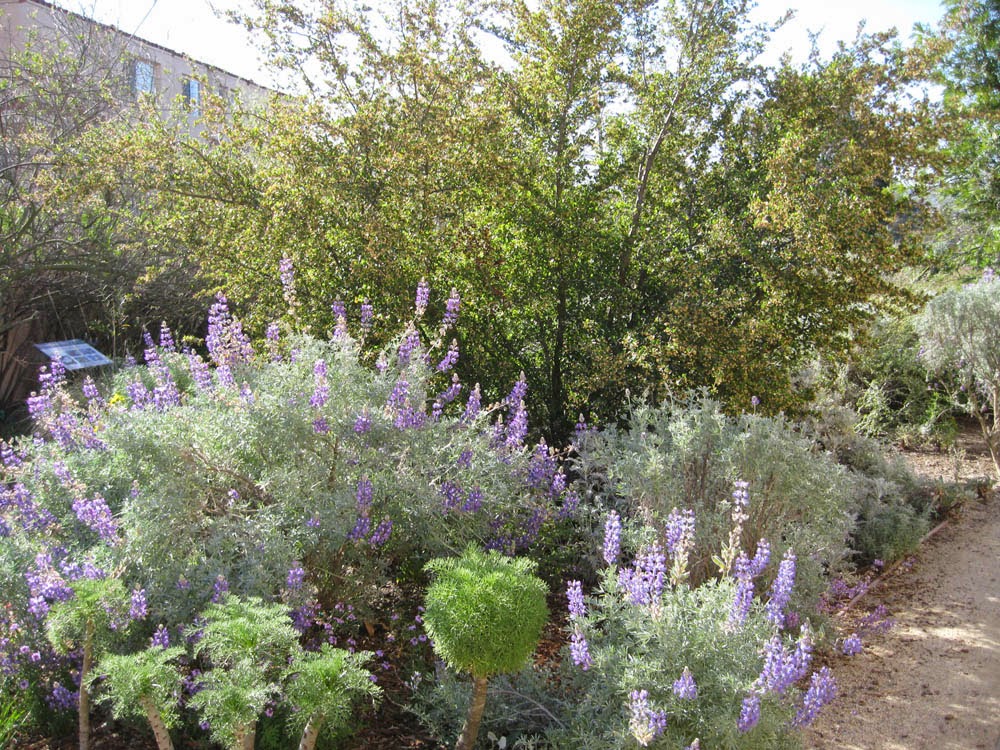


The native lupines – annual and perennial – blanket the garden with waves of purple in a normal year.  Ceanothus species, from trees to low-growing groundcovers, are at their best.   If you love blue and purple, this is your time of year.
 

Gardens in April have the lush look of spring.  That’s why so many garden tours occur in April.   Be sure to keep up with weeding – it will save time later.

All the lush new growth may attract garden pests, such as aphids and other sucking/chewing insect. If you garden with California native plants, the pests are usually not a major problem.  If aphids are rampant, try blasting them off with a stream of water.  If that doesn't work, try a solution of water and insecticidal soap.   One of the real benefits of gardening with native plants is the time and money saved fighting spring insect pests.


March and April still produce some rain in a normal year.  If the soil is drying out in early April, don’t hesitate to provide a good soaking.  Even drought tolerant natives need moist soil from November/December through April.
 

By late April and May, the soil is drying out and the later spring wildflowers like Clarkias and Gilias are coming into their own.  Clarkias are sometimes known by their common name – Farewell-to-spring. Look for early butterflies on Salvias (sages) particularly the Purple and Black Sages (Salvias leucophylla and mellifera).  Among the butterflies you may see are the Mourning Cloak, Western Tiger Swallowtail and Monarch. 


You can still get in another deep soaking in late May if you time it with a cool, overcast period.


The Dry Season


By June, local gardens are usually entering into the delightful period known as the dry season.   The days are long, the fog burns off early, and the garden is alive with activity.  This is many local gardeners favorite time.

 
In many years, the Salvias (sages) are finishing their bloom in June-July, just at the time the early buckwheats are beginning their bloom season.  This period marks the start of the peak butterfly and pollinator season (June-August).


Areas that get regular water look particularly lush from July to September.  The large evergreen shrubs from the Chaparral, including Ceanothus, Manzanita, Coffeeberry, Keckiella, wild rose, Carptenteria, Summer Holly and Toyon have mostly finished blooming and are sending out new growth.  Choose a cooler period to prune these shrubs, if needed, after flowering is complete.   This is also the time to hedge-prune, while shrubs are actively growing.


Elderberries, late currants and Manzanita fruits ripen, to the joy of jelly-makers and fruit-eating birds.   In August and September, dragonflies search for prey and rest on convenient stalks.


Summer-blooming sunflowers add color and a treat for pollinators.   This is a good time to sit in the shade and enjoy the garden with a glass of iced tea made from native mints.  Browse through the seed catalogues and order native seeds and bulbs.  Summer is the best time to order, before the supplies are depleted.  For a list of native seed suppliers, see the Seed Sources/Nurseries page. 


As the season progresses, the garden takes on a golden brown appearance as grasses dry and buckwheats go to seed. Take time to enjoy your garden in the late afternoon and early evening. The sunlight filtering through the dried grasses is enchanting.  If you've planted a native Brickelbush [Brickellia species] your late afternoon garden will be perfumed by its sweetly scented flowers. 


The Dormant Season


From the end of August to the beginning of the wet season many local native plants take their season of rest – the dormant season.  September often is our hottest - and driest - month.

 
While evergreen shrubs show no effects, deciduous trees and shrubs begin to lose their leaves.   This is not to say that nothing blooms from August to October.  In fact, a surprising number of shrubby members of the sunflower family are at their peak this time of year.  The same is true for California fuschia, a plant whose welcome flowers bring hummingbirds like magnets.

 
Overall, the garden is a symphony of browns; a restful blend of colors that is subtle and soothing. This is a good time to add hardscape features and to take a close look at your garden design.  Are there plants that are not doing well?  Bare spots?   Could your garden attract more birds and butterflies?  Would you like to include more edibles?  Your local native plant society and/or nursery likely has a fall plant sale.  Fall native plant sales are the perfect opportunity to buy plants needed for Wet Season planting. 

 
As the days get cooler, it’s time to prune many local sub-shrubs, some of them rather drastically.   In nature, these plants would be eaten down by browsers this time of year.  In the garden, we accomplish the same with pruning.

 
It’s a good time to renew mulch, start plants from seed and prepare the gardening tools for winter.   Also a great time to use the fall pruning to dye yarn/fabric, or create a custom-made potpourri. If you're inspired, look for our 'crafts' postings on this blog.

 
It’s also a time to sit back, take a rest and enjoy one of the prettiest times of the year.


And now we’re back where we began.  The rain clouds are building, the days are cool and it’s time for the rains to begin again.  What a wonderful year in the garden!

_________________________________________________________________
We welcome your comments (below).  You can also send your questions to: mothernaturesbackyard10@gmail.com

Monday, September 1, 2014

Plant of the Month (September) : California goldenrod – Solidago velutina ssp. californica (Solidago californica)


California goldenrod – Solidago velutina ssp. californica (Solidago californica)
 in Mother Nature's Backyard


By September, the garden is awash with tan, pale gold and rust-orange as grasses dry, buckwheats go to seed and many plants enjoy their fall dormant season.  In this symphony of browns, members of the sunflower family add a note of pure golden yellow.  One of our personal favorites is the California goldenrod, Solidago velutina ssp. californica.

California goldenrod is among several goldenrods native to western Los Angeles county.  Solidago confinis  (Solidago spectabilis var. confinis), the Southern goldenrod, once flourished from the coast to the San Gabriel and Verdugo Mountains.  The Western flat-topped goldenrod (Euthamia occidentalis) covered seasonally moist areas throughout California, including at the Dominguez Slough (currently the Gardena Willows Wetland Preserve). 

The California goldenrod itself is still widespread throughout California.  Locally it can be found in the Santa Monica, San Gabriel and Santa Susana Mountains, in Griffith Park and on Santa Catalina Island.   It grows in a number of California plant communities including coastal sage scrub, chaparral, oak woodlands and riparian forests/woodlands at elevations less than about 8000 ft.    Generally, the areas are at least seasonally moist, although they may be quite dry in summer.

For many years California goldenrod was known as Solidago californica.  In fact, most of us still think of it by that name.  The Goldenrods, like other native plant species, have recently been re-evaluated by genetic taxonomists.   Similarities at the DNA level suggest that many local variants, including the Arizona, Nevada and California goldenrods, belong together in the species Solidago velutina.   So we’ll just have to get used to a new name for an old favorite.  

While we’re on the topic of names, the name Solidago is derived from the Latin ‘solido’ – to heal or make whole – referring to the medicinal qualities of this genus.  In fact, California goldenrod is useful in several ways, including as a medicinal.  We hope its many properties will make you want to include it in your garden.
 

California goldenrod – Solidago velutina ssp. californica (Solidago californica)
 in Garden of Dreams, CSU Dominguez Hills, Carson CA


California goldenrod is a spreading perennial that dies back after blooming (late fall/winter) and re-grows again in spring.  A mature plant produces many upright stems, 2-4 ft tall and crowned with clusters of flowers.  In general, plants that receive more light and water – and those in clay soils -  tend to grow taller and more robust.    


California goldenrod leaves are alternate and become smaller and more elliptical the further one moves up the stem.  The lower leaves are oblong, often toothed and clustered at the base of stems.  The foliage varies from a medium green to gray-green; some plants have leaves that are densely fuzzy.   The stems often have a tinge of red or purple.

California goldenrod – Solidago velutina ssp. californica (Solidago californica) against a fall sky


California goldenrod blooms in fall, from late August through October in our area. The name ‘goldenrod’ well describes the arrangement of the flowers.   The small flowers are arranged in a wand-like arrangement at the ends of the stems, creating a wall of golden yellow in a good year (above).   On closer observation, the flowers are actually small sunflower heads, complete with flat ray flowers and yellow central disc flowers.  There are literally hundreds of small flower heads on each flowering stalk.

California goldenrod – Solidago velutina ssp. californica (Solidago californica)  - flowers
 
California goldenrod with Fig-eater Beetle and European Honey Bee
 

If you look closely at the picture above, you’ll note several common insect visitors.  The large green Figeater beetle is likely eating the flowers or pollen.  For more on this interesting local beetle see: http://mother-natures-backyard.blogspot.com/2013/08/green-fig-beetle-figeater-beetle-green.html       The European Honey Bee is among the many types of bees attracted to California goldenrod.   In fact, the goldenrods are excellent pollinator habitat plants.   They bloom in fall, when food can be scarce.  Their abundant flowers, with their tasty nectar and pollen, provide an important source of food for adult pollinators and their offspring.

California goldenrod can be a great educational resource for children and adults.  Pull up a chair on a sunny day and you’ll likely see an amazing array of insects.   You’ll first observe the fall flying butterflies like Skippers and Blues – perhaps even a hummingbird or two.  But sit quietly and notice all the tiny insects, including numerous species of native bees, flower flies, beetles and other insects.  You may even find a spider waiting patiently for insect prey.  In fall, the California goldenrod is its own little ecosystem, teeming with life.
 
Phidippus californicus – Jumping spider on California goldenrod

In late fall, California goldenrod produces copious fluffy seeds that spread by wind.  The seeds are eaten by finches and other seed-eating birds, so we leave them on the plants awhile.  When it’s time to tidy up in late fall or early winter, cut your goldenrods back to just a few inches.  They will sprout back revived and healthy in the spring.
 

California goldenrod - ready for pruning back in late fall

 
California goldenrod is fairly easy to grow.  It likes full sun (and flowers best under these conditions) but tolerates light shade and even works as a groundcover under tall trees.   It does fine in most local soils and is particularly well adapted to clay soils.  While quite drought tolerant, it stays green and blooms longer if given occasional summer water.  We grow California goldenrod around our bubbler fountain, where it gets an occasional splash.  We’ve watered it three times since May in our clay soils.   The lower leaves are beginning to turn brown in late August - but this has been a very dry year indeed.

California goldenrod is a spreader.  The goldenrod ‘patch’ will increase in size each year, as the plant spreads via underground stems (rhizomes).  In our experience,  plants given only occasional summer water spread rather slowly; they are easily contained by removing unwanted stems in spring/summer.  That being said, this plant is an opportunist; like many local riparian plants it will take advantage of available water and grow vigorously with regular irrigation.  If worried by its propensity to spread, grow California goldenrod in a contained area: a planter, small contained area or even a large container.

Goldenrods are used too infrequently in local gardens, perhaps because they are sometimes viewed as weeds.  They have an undeserved reputation as allergens; in fact, the culprit is usually ragweed, a species that blooms concurrently with the goldenrods.   At any rate, goldenrods are unequalled in their ability to brighten up a fall garden.  Given their size, they are best used contained or mid-bed in a mixed planting with Yarrow, Erigerons, Asters, milkweeds, native grasses and shrubs. 


California goldenrod – Solidago velutina ssp. californica (Solidago californica) at base
 of solar fountain - Mother nature's Backyard

Goldenrods are a must for habitat gardens.  They are among the few fall-blooming native perennials, making them essential in gardens too small for the larger shrub Sunflowers.   In addition, California goldenrod is a very useful plant.  Very young leaves & shoots can be used as cooked greens in spring.  Leaves can be dried and used as a soothing tea. 

Goldenrods have been used medicinally where ever they grow.  Native Californians use powdered, dried leaves as a disinfecting powder for skin sores, wounds, burns and rashes.  A decoction (tea) made from leaves was traditionally used for feminine hygiene, as a wash for skin sores and to prevent hair loss.  

Yarn dyed with California goldenrod – Solidago velutina ssp. californica (Solidago californica)


Crafters also find good use for goldenrods.  The flowering stems make good dried (pressed) flowers that retain their color for years.   Flowering stems and leaves can be used to make lovely soft yellow dyes that can be used to color wool, silk or cotton yarn or cloth. 

In summary, California goldenrod is a lovely plant that attracts many insect visitors in fall.  It has many useful properties and is a joy to behold in the fall garden.  We hope you’ll consider this plant when you visit the fall native plant sales!


For plant information sheets on other native plants see: http://nativeplantscsudh.blogspot.com/p/gallery-of-native-plants_17.html


We welcome your comments (below).  You can also send your questions to: mothernaturesbackyard10@gmail.com


Sunday, August 31, 2014

Designing Your New California Garden: 11. Creating a Design Plan, part 3


Last month we discussed several Artistic Principles (Elements of Design); tricks of the trade for designing a more pleasing garden.  If you didn’t read last month’s post, take the time to read it now:  http://mother-natures-backyard.blogspot.com/2014/07/designing-your-new-california-garden-11.html This month we consider additional design principles and create a preliminary planting plan.  


If you’re just joining the ‘Designing Your New California Garden’ series, we suggest starting at the beginning (July 2013 - http://mother-natures-backyard.blogspot.com/2013/07/designing-your-new-california-garden-1.html) and working forward.  The monthly activities will help you design an attractive, functional, sustainable and water-wise garden.


More Artistic Principles (Elements of Design)

Several design principles apply to the overall design.  These are a bit more difficult to understand, but we’ll do our best to explain them and provide examples.

Unity/Harmony – refers to the harmony between all parts of the design to create a pleasing whole.  A harmonious design feels complete.   The parts all  work well together and the design looks planned. 

One of the easiest ways to achieve harmony is to choose a unifying garden theme.  Whatever the theme – ‘purple flowers’, ‘Japanese Garden’ or ‘coastal sage scrub plants’ – a theme creates a unified appearance.   The theme limits choices and results in harmony.

Unity should be considered when choosing both plants and hardscape.  In fact, a unified hardscape scheme is another easy trick for achieving harmony.   Select path/patio materials, pavers, mulch and other hardscape materials with similar characteristics: color, texture, etc.   Use walls, fences, screens and arbors of the same material, color and design.  The garden will exhibit unity, even if your plant materials demonstrate variety.

Some gardens include views of nature. Using locally native plants and hardscape connects the garden with the local native landscape, creating a harmonious whole.  Consider choosing the local native plant palette as your  theme, particularly if your garden has inspiring views of native scenery.


Balance – involves the distribution of the visual weights of objects, colors, textures and space.  This principle works hand in hand with proportion and scale to provide a design that feels stable.  You can think of balance in terms of a scale: the two sides of a design should appear to have equal ‘weight’ in terms of their visual characteristics.

Have you seen a garden with a large, dense hedge on one side and nothing on the other?  The yard probably seemed unsettled or unfinished.  This is because the design was unbalanced; all the ‘weight’ was concentrated on the side with the dense hedge.   Another example is a front yard with a large, decorative planter on one side and grass on the other.    The yard appears unbalanced because there’s nothing substantial to counter the visual ‘weight’ of the planter.

There are several ways to create balance.  In symmetrical balance, elements in one half of the design mirror those in the other.  For example, a large  planter is balanced by its twin on the other side of the front yard.  Pathways, fences, screens, planters and other prominent hardscape elements are often used to achieve symmetrical balance.    For example, symmetrically balanced pathways are used in formal herb or parterre gardens: the design is geometric, with one half the mirror image of the other.

Symmetrical balance can also be used in designing the planting plan.  A large shrub or mass of colorful flowers is balanced by a similar mass.   Or the shape and content of a flower bed is repeated, or mirrored, on both sides of the garden.  Symmetrical balance is easy to achieve; you simply split the area in half (or quarters) and repeat the design elements.

Symmetrical balance has a formal appearance.  If you like a formal look, use geometric shapes and symmetrical balance in your design.  In fact, symmetric balance can create a neat, balanced look, even if the plants themselves (herbs; vegetables; native plants) have an informal appearance.    That’s one reason why formal herb gardens are so appealing – they provide a nice juxtaposition of formal and informal.

Some very formal, planned gardens feature another type of balance: asymmetrical balance.   Gardens with an Asian influence, such as formal Japanese style gardens, provide excellent examples.  In asymmetrical balance, the two sides are different but still appear to ‘weigh’ the same. 

Asymmetrical balance is more difficult for beginning designers to achieve.  But you can train your eye to appreciate and use it by observing good examples.  Japanese gardens, particularly the large formal gardens found in many large cities, take asymmetrical balance to a high level.   We suggest visiting or studying a good book on classic Japanese gardens. Note how plants, rocks and other features are placed to create a balanced design.  You will note that design elements are usually in groups of three, five or other uneven numbers.

Asymmetrical balance is also used in informal or natural gardens.  Paths may meander and plants appear as if planted by Mother Nature herself.  But the overall view across the garden should still appear balanced.   For example, a single large shrub may be ‘balanced’ by a cluster of smaller, dense shrubs that have the same visual ‘weight’.   Or an accent plant, with unusual foliage color, is balanced by a larger evergreen shrub.    The key is to have neither side more prominent (‘heavy’) than the other.

A third type of balance is radial balance.     In radial balance the design elements are arranged around a central point, somewhat like the spokes of a wheel.  The design may feature a full circle or, more commonly, a half- or quarter-circle.  Radial balance can be used to create striking garden designs.  Currently, it’s most frequently used for decorative vegetable and herb gardens.  But radial balance is the basis for many an interesting garden.


Movement describes the path the viewer’s eye takes through a design or work of art.  The best garden designs are balanced, but not static.  The eye travels through the garden, creating a sense of movement, change and interest. 

Movement can be directed along lines, edges, shapes, and color within the design. Generally, the eye focuses first on elements that are dark, brightly colored or otherwise accented.  Lines direct the eye from their beginning to end; we naturally follow lines.  Likewise, repetition of a color or shape leads the eye along the path of least resistance, from like to like.  For more ideas on use of movement in garden design, with some excellent examples, see: http://www.gardendesignexposed.com/rhythm_and_motion.html

 
Use of Vertical Space.  Design is all about the use of space; vertical space refers to the space above the ground.   Gardeners with small gardens often exploit vertical space creatively.  But its effective use is a hallmark of good garden design, even when space isn’t an issue. 

Beginning designers often underestimate the importance of vertical space.  They concentrate on very low-growing plants (grass; groundcovers) and large plants (trees).  But the best gardens (and nature itself) include plants of many heights, including medium and large shrubs, perennials and vines/climbers.    

Utilizing all levels vertical space creates a more interesting garden. It allows you to use space effectively, thus including more plants.  The increased variety attracts more birds, butterflies and pollinators.  So there are both design and practical reasons to use your vertical space.


Garden designers often refer to the ‘ground’, ‘foreground’, ‘mid-ground’ and ‘background’ areas of a design.  The ground layer is planted with very low plants – grasses, lawns and low groundcovers for the most part.  In some gardens, the patios, seating areas, walkways and other low hardscape are important elements of the ground layer (see above). 

The foreground is the next tallest layer.  It’s the area nearest the viewer – in the front of beds, directly adjacent to paths and seating areas, etc.   The foreground features plants that are best viewed up close. Foreground plants are the ‘lead actors’ and ‘divas’ in the garden drama.  They often are plants with special attributes – interesting flowers, foliage or form (see the succulents in the foreground, above) or delicate scent.  

Of necessity, foreground plants are also the shortest, usually in the 1-2 foot range.   Many gardeners include annuals and bulbs in the foreground.  But smaller decorative grasses, succulents, cacti, ferns and perennials are also candidates. 

The mid-ground provides additional interest to the design.  Composed primarily of plants in the 2-5 foot range, the mid-ground takes up most of the space in a typical garden/garden room.  In California, the mid-ground is primarily composed of smaller shrubs, half-woody sub-shrubs and larger perennials.  These plants are often chosen for their foliage attributes, although they may also have flowers and interesting fruits/seeds.   

Since mid-ground plants are viewed at a greater distance, they are most important for the overall impression they give; ‘white foliage’, ‘purple flowers’, ‘small leaves’, etc. They often are massed to increase their impact.     Many mid-ground plants have seasonal attributes (purple flowers) in addition to their season-spanning foliage, shape and texture. In the photo above, note how mid-ground plants add foliage color (silvery; green) and interesting shapes in addition to the overall impression of ‘purple flowers’.   

Mid-ground plants provide masses of color and texture that contrast with the unique attributes of the foreground.  They are the ‘supporting actors’ in the garden play.   Accents, sculpture, bird baths and other garden art are also most appropriate for the mid-ground.   They are large and unique enough to compete with the mid-ground plants.  And they stand out nicely against the background. 

The background serves as a backdrop for the fore- and mid-ground.  Like a stage backdrop, background plants provide contrast to showcase the plants (actors) in front of them.  They are often chosen to provide maximal contrast.  Background plants tend to be evergreen, medium to dark in foliage color and of simple, dense texture.   Note how the darker, relatively dense background shrubs/trees showcase the fore- and mid-ground plants in the photo above.   

Composed primarily of trees and large shrubs (more than 5 ft. tall), the background can also include taller hardscape elements like walls, fences or screens.  In fact, hardscape often provides important background in smaller gardens typical of suburban California.  Some gardens feature vines and shrubs grown on trellises or espaliered on a wall or fence.   Pleasant views – ‘borrowed landscape’ such as surrounding trees, hills, etc. - can also form part of the background.    

It’s important to remember that the background is meant to be a backdrop.   In most cases, background plants should not serve as accents; and unless there is good reason to accent them, background fences/walls should be of a medium to dark color.  When choosing background plants/hardscape, remember that their primary design function is to showcase the plants in front of them. 

As seen in the photo, well-designed gardens usually provide natural transitions between the vertical layers, with no large gaps in height between the layers.  Some very formal contemporary gardens are the exception to the rule; their geometric designs actually feature sharp contrasts between vertical layers.  But in most gardens, plantings should not resemble a series of steps.    Height should vary within the layers, creating a more natural appearance.   

 
For more ideas on planning vertical space see: http://edis.ifas.ufl.edu/ep449      


But enough talk.  Let’s see how these design principles are used in practice. 
 

Creating a preliminary planting plan (layout)

In the last posting, we suggested breaking up the garden into manageable pieces.  We used the example of the garden at 112 Willow Street and began by creating a Summary of Characteristics for several areas of the garden.  This month we’ll tackle a slightly more challenging area: the ‘Butterfly Garden’


The Butterfly Garden is located at the back of the lot, near the ‘Lawn’ and ‘Vegetable Garden’.   As currently envisioned, the area is long and relatively narrow; it’s separated from the Lawn by a simple stone border.  It’s a highly visible area, with views from the house, patio and ‘Shady Seating Area’.  Our gardeners begin with a Summary of Characteristics.  


At this point, it’s helpful to step back and critically review the basic layout for the entire area.  The gardeners enlarge their site map and note the dimensions of the Butterfly Garden.


A six foot depth is fairly narrow for a garden/garden bed.  When the gardeners pencil in some representative plant sizes, they observe that it may be difficult to use their vertical space in a pleasing way.   Unless they want to limit their plant palette to smaller plants (or a hedge & espalier), they need to make the garden deeper. Increasing the depth to 8 feet will decrease the ‘Lawn’ slightly, but expand their options dramatically. 


The gardeners draw in the stone border and pavers.  The new layout has space for some larger shrubs, in addition to smaller plants.   In fact, their design can now include limited fore-, mid- and background areas.   This will be far more interesting and provide additional area for butterfly habitat.


Let’s review how the principles of design are currently reflected in the backyard at 112 Willow St.  The three main planted areas (‘Lawn’, ‘Butterfly Garden’ and ‘Vegetable Garden’) are treated as three garden rooms, separated by stone/planted borders.   The viewer can see the entire backyard, but still gets a sense of enclosure for each area.   The entire backyard is surrounded by a 5 ft. tall fence, increasing the sense of enclosure. 

The backyard is unified by the theme: ‘food for all’.  The hardscape colors and textures have been chosen carefully.  They provide a uniform, natural appearance and their grayed colors will blend into the landscape.  The same mulch will be used in the Butterfly and Vegetable gardens.  The hardscape unifies the entire backyard, producing an additional sense of harmony across the three ‘rooms’.

The stone border provides a semi-formal separation between Lawn and Butterfly Garden.  Our gardeners lay out their proposed border with a rope and spend some time observing its lines.  They decide to extend the border to include a narrow area between the Lawn and Vegetable Garden. The line of the stone border now forms a rough semi-circle, providing symmetrical balance.  The sweeping arc leads the eye on a panoramic view of the entire backyard (creates a sense of movement).  The shape of the arc is reinforced by the line of the perimeter fence.

The garden at 112 Willow demonstrates how hardscape provides the backbone of the garden design.  It sets a tone that is semi-formal, helps to define several outdoor rooms, provides a feeling of unity and leads the eye by creating a pleasing line for the eye to follow.  Even with no plants in place, the hardscape creates an interesting landscape.

The gardeners next consider the plants for the Butterfly Garden.  Note that they are defining the characteristics of the plants; their cultural, size and other characteristics.   They are not choosing specific plants at this stage. 


The general plant characteristics reflect cultural conditions particular to the site (light; soil; drainage; etc.) as well as the functional and aesthetic standards that all plants must meet.   Since this is a butterfly garden, all plants must provide something (mostly food) for either adult or juvenile (larval) butterflies.    The gardeners have learned that native plants are particularly good butterfly plants, so the garden will emphasize California natives.

Native plants often have a somewhat informal natural shape.  While some native shrubs can be pruned to quite formal shapes, many gardeners prefer a more natural look – tidy but not too manicured.   This also makes gardening easier, limiting pruning to several times a year.  The informal appearance of native plants lends well to asymmetric balance.   In the garden at 112 Willow Street, the hardscape utilizes more formal, symmetrical balance, while the plants will be balanced asymmetrically.

The easiest place to begin is the background layer.  It features the largest plants - those most difficult to place in a small garden.  Because their primary role is to provide a backdrop, they tend to have more simple characteristics; but their size, both vertical and horizontal, is of critical importance.  As noted below, a background plant will be given additional points if it has flowers/fruits (added value).


The gardeners now must place the background plant(s) in space.  In creating a rough layout, they must consider both the horizontal (map or plan view) as well as the vertical placement (elevation view).  To maximize their limited space, the gardeners decide to locate a single large shrub in the roomiest part of the Butterfly Garden.  They place an appropriately sized circle on their map (below).


Now the gardeners consider the elevation view.  First, they create a background elevation plan/drawing.  They can either draw it on paper (to scale) or create it on the computer.  They can then use shapes or cut-outs of plants (paper or digital) that can be moved around, allowing them to see how the design will look. 

Our gardeners have access to PowerPoint and a scanner,  so they create their elevation view digitally.  They scan in a picture of a fence (similar to the actual fence) and create a scaled elevation plan, adding in the lawn (ground layer).    Here’s how their elevation looks with the hardscape in place.  The perspective isn’t perfect, but it’s fine for their purposes.


A quick look from the porch reminds the gardeners that their background layer is  more complex than currently depicted.  They add the ‘borrowed’ distant trees to their elevation plan. This now reflects what the viewer will see when they admire the garden.


The background layer will include the perimeter fence, ‘borrowed’ views and some medium to large (5-7 ft. tall) shrubs.   This is fairly typical for a small garden.  The gardeners add the large background shrub to see how well it fits.


The large shrub counter-balances the distant trees, forming a balanced background.   In fact, the Vegetable Garden (not shown) also adds weight to the right side of the design.   The gardeners will need to consider this when they place  additional plants and accents (such as the birdbath).   In total, elements on the left side must have sufficient visual weight to balance the Vegetable Garden.

The Butterfly Garden has limited space for mid-ground plants.  The California native shrubs which will comprise most of the mid-ground are of two types: shrubs in the 5-6 ft. diameter range, and smaller sub-shrubs/perennials in the 3-4 ft. range.  The gardeners decide to tackle the larger shrubs first, as these will be more difficult to place.  The garden can accommodate only 6 or 7 plants with 5-6 ft diameters. 


Because the mid-ground provides most of the over-all ‘feel’ of the garden, our gardeners have considered the characteristics of these plants carefully.  They will provide masses of foliage/floral color.  They will likely provide much of the nectar adult butterflies will use as food, so bloom season is an important consideration. 

The foliage will provide contrast with the background and with other mid-ground plants.  Fortunately, California native shrubs offer an abundance of foliage characteristics.   Because there is limited space, the plants will need to be chosen carefully - but that’s next month’s task.  Now the gardeners simply need to locate them on the map.


Note how the gardeners grouped the plants, rather than simply spreading them throughout the garden.   Another option, briefly considered, was to form a shrub hedge along the perimeter fence.  This was rejected because the gardeners felt it would look ‘boring’.  The informal groupings add just the right amount of complexity to the design.   

The garden will include a decorative birdbath.  The gardeners need to decide on the actual piece before they locate it in the mid-ground.  They will place the birdbath where it provides easy access for birds and viewing.  But they will also highlight its decorative features by proper placement.

The gardeners add the larger shrubs to their elevation plan, using cutouts of representative plants. At this point, the gardeners are creating a rough layout; they may need to fine-tune placement once actual plant species are chosen.  For their representative plants, they choose examples with different foliage characteristics and sizes to more closely represent how the garden will appear.


The gardeners have repeated two of the larger mid-ground shrubs; one with medium green foliage and another that’s grayer.   Notice how the repetition adds ‘motion’ to landscape as your eye naturally moves from like to like.  There is just enough variability to keep the garden from being static (boring).

Given a limited number of plants, beginning designers may be tempted to plant ‘one of each’ to increase the number of plant species.   When choosing mid-ground plants, remember that repetition (mass planting) produces a better design.  If you want to increase the number of species, choose several with a similar overall appearance to give the illusion of repetition.


The smaller sub-shrubs and perennials, with diameters of 3-4 feet and heights from 2-5 feet, are appropriate as fillers in the mid-ground.  Some of the shorter plants might also work as foreground species.   The smaller sub-shrubs and perennials will be an important source of caterpillar food.  In fact, this will be a key attribute of the plants chosen.  Others will be selected because they bloom during off-season periods – early spring and fall.  


Smaller plants are relatively easy to locate once the larger plants are in place (above).  Notice how quickly the space is filling up.  The gardeners will need to choose plants with the appropriate final (mature) diameters, or they will end up with too many plants in their small space.  Some trees and shrubs look small at planting but quickly grow to impressive size.   Over-planting is a common mistake (particularly with California native plants).  That’s a costly error the gardeners at 112 Willow St. want to avoid.


The current elevation looks pretty good.  There is variability in height and other characteristics.  The gardeners repeat several plants, using the principle of repetition.   All that’s left is to add the foreground.

Our gardeners have taken the design principles to heart.  The foreground plants provide the interest – color, seed-pods, seeds, scents – that is lacking in the other layers.   The foreground will likely include some plants chose specifically as caterpillar food.  


The foreground plants will complete the garden.   They will also serve as fillers between the larger plants, particularly in the early days, when larger plants have yet to reach their mature size.   The final elevation drawing gives the gardeners an idea of how their mature garden will appear.


The gardeners at 122 Willow St. have accomplished a great deal this month.  Note the care with which they’ve defined plant characteristics for each tier of the garden.  This work will pay off next month when they select their plant species (Sept/2014).    Instead of feeling overwhelmed, they will confidently search for plants that meet specific criteria.  And we’ll introduce some great resources to help them in their search.

The gardeners have also produced a draft layout plan.  This will be modified as the actual plants are selected.  But the basic plan – the backbone of the final planting plan – is done.   The design looks good in both the map and elevation views.

Good luck in developing the Summaries of Characteristics and draft layout plans for your own garden. Review your Garden Notebook to refresh your memory about relevant site characteristics, family needs/desires and hardscape choices.  Take the time to think, dream, and try out different arrangements.  Sit in the garden, with the plans in hand, and visualize your New California Garden.

 See you back next month. 


We value your comments (below).    You can also contact us directly at mothernaturesbackyard10@gmail.com.