

California
native plants are useful as well as attractive.
In fact, many have significant histories as medicinal plants. This
should not surprise us; plants produce a wide range of chemicals for their own
protection. It turns out that some are
also effective against human pathogens and conditions.
Western
medicine is just beginning to discover the benefits of chemicals produced by
locally native plant species. There is
also increasing interest in the many practical uses of California native
plants. That’s one reason why we
created Mother Nature’s Garden of Health (http://mother-natures-backyard.blogspot.com/2014/03/our-new-garden-mother-natures-garden-of.html).
Most
of us suffer from joint and muscle aches every so often. Pain medications can
cost a lot – and have serious side effects.
What if there were an inexpensive alternative that could be applied
externally to help reduce the aches?
It
turns out that several native plants have long been used to ease painful
muscles and joints, usually in combination with warm water. If you grow these plants, you may want to try
them to see if they work for you. They
may provide a useful complement to Western medicines, working in concert with
them.
A Word of Caution
First,
a word of caution. Plant based medicines are medicines; just because they come
from plants doesn’t automatically make them safe. Any
medicine has the potential to help or to harm – even to kill. The following
precautions should be taken when using any plant-based medicine (including
those purchased or made from common garden herbs):
·
First, get a diagnosis from your
doctor. You need to know whether that pain or
other symptom is due to a serious condition or not. Many
serious acute conditions require prompt treatment with Western medicines.
·
Check with your doctor before using a
plant-based medicinal. Some medicines, including herbal ones,
interact with common medicines for diabetes, hypertension, cholesterol,
depression and other conditions. You
don’t want to have a serious drug interaction – or lessen the effectiveness of
another drug you’re taking. So check with your doctor before starting any
new medication.
·
Be sure that you are using the correct
species – misidentification of plants can be deadly. So identify a plant correctly (ask for help
if you need it) before using it as a medicinal. Even if there are no deadly
consequences, a misidentified plant may waste your efforts or give an
unexpected result.
·
Use only plants collected from your
own yard (or other gardens
which have not been treated with pesticides).
·
Prepare the medicinal using a
recommended recipe; follow
the recipe exactly.
·
Start with a small dose.
Everybody is allergic to one
chemical or another. It’s better to discover your allergies with a small
dose. If you note any sign of an allergy
(pain; redness; swelling; trouble breathing; or other symptom that doesn’t seem
normal) stop using immediately.
·
To
be extra safe, use plant medicines only
for external applications. Medications applied externally to the skin or
joints usually have less potential to harm than those taken internally. Those dissolved in water (soaks and baths)
are even better.
·
Consider
using only plants from plant families
that are generally non-toxic to humans.
Plants in the Mint (Lamiaceae)
and Sunflower (Asteraceae) families
are generally safe and have a long history of use as herbal medicines and as
foods.
·
Limit your use: don’t over-dose on any type of
medication. Be sure you know the proper
dose – and don’t exceed it. If you
experience unusual symptoms – or if the effectiveness decreases over time –
stop using the herbal medicine.
·
No medicine is effective for everyone.
This is true for herbal and Western medicines, alike. So don’t be surprised if an herbal medicine
that’s effective for a friend does nothing for you. Make a small first batch. If the medicinal works for you, then make
more.
·
Be sure to clearly label plant-based medicines and store them
safely. Treat them like the medicines they are!
·
Most herbal medicines have not
been evaluated for safety and efficacy by the U.S. Food and Drug Administration
(FDA). So know that you are using these medicines
without the safety net provided by the lengthy evaluations required by the FDA
for licensed drugs. Follow the
precautions list above and listen to your body’s signs. Stop using a plant-based medicine if your
body signals that something is wrong.
Some Definitions
Most
medicinal plants must be processed to be used effectively. Like the natural dye chemicals (http://mother-natures-backyard.blogspot.com/2013/10/garden-crafts-colors-of-california-dyes.html), medicinal chemicals are produced
and sequestered in plant tissues. While
some are excreted on the surface, many are found only in the deeper plant tissues. Their release requires breaking the plant tissues
and cell walls, either by mechanical means (grinding or pounding to create a
poultice), by drying, by applying heat or by using extraction solvents.
Extractions
using cold or hot/boiling water are common in traditional healing practices. Those
made from softer plant parts (flowers, leaves), which require shorter
extraction times and less heat, are properly called infusions. When you make a cup of tea, you’re making an
infusion.
Water-based
extractions from harder plant materials (bark, roots, tough leaves, seeds)
require longer extraction times. The result is properly termed a decoction.
Both infusions and decoctions
are either drunk as a medicinal teas or applied externally to the skin, to
swellings, painful muscles/joints, or to wounds. Most healing cultures use water-based extractions
extensively; and many teas enjoyed today had their beginnings as medicinal
teas.
An
alternative extraction method is to create a tincture, using alcohol
or another solvent to break down the plant tissues and extract medicinal
chemicals. Strictly speaking, tinctures
are alcohol extractions; but
extractions using vinegar and food-grade glycerin are sometimes also called
‘tinctures’.
Tinctures
also have a long history of use in traditional medicine. They
have the advantage of being more concentrated than water-based extractions,
making them easier to store and transport.
They also last longer – at least several years if stored properly. They
are often more fast-acting than infusions (due to the alcohol) and the chemicals
extracted may differ from those extracted using water. Thus, a tincture may have entirely different medicinal
properties than an infusion/decoction made from the exact same plant material.
The
types of alcohol used to make home tinctures are most often either vodka or
brandy, with vodka being used most often.
Both are readily available and tinctures made from them can be used
externally or taken (with caution and at the proper dose) internally. Vodkas
should be 80- or 100-proof (40 or 50% alcohol) to properly extract the plant chemicals.
 |
| Anemopsis californica - medicinal plant used for muscle & joint pains |
California Native Plants for Muscle
and Joint Aches/Pains
Several
California native plants provide relief for painful joints and muscles. Some only relieve the pain (are analgesic). Others work by reducing the swelling in
inflamed tissues, or both. The plant
extractions we’re concentrating on here are those that can be applied
externally – either applied directly to the painful area or dissolved in warm
water for a soak or bath.
The
table below gives some of the most commonly used species in S. California. Fortunately, these are also plants grown in
local gardens – you may already have a good supply right in your own garden. Fall is a good time to prepare tinctures or
to dry plant parts obtained from fall pruning.
|
Name
|
Plant part used
|
Preparation
|
Other notes
|
|
Anemopsis californica
Yerba mansa
|
Root (fresh or dried); best collected in fall/winter. Chop into
pieces.
|
Tincture: fresh root 1:2* ; dried root 1:5
|
Can be used with Heterotheca
|
|
Arctostaphylos species
Manzanitas
|
Leaves (fresh or dried)
|
Infusion: standard infusion 2-6 oz. plant material/dose
Tincture: 1:2 fresh; 1:5 dried
|
Use in warm water or bath+
|
|
Artemisia californica
CA Sagebrush
|
Foliage, branch trimmings (dried; then strip off leaves/flowers)
|
Decoction: strong (1:3 parts hot water)
|
Apply warm decoction with moist cloth
|
|
Artemisia douglasiana
Mugwort
|
Leaves (dried). Collect summer or fall
|
Infusion: hot or cold water extraction
Tincture: 1:5 in cider vinegar
|
Apply directly to skin with moist cloth. Good for larger joints.
|
|
Clematis species
Virgin’s bower
|
Foliage (fresh or dried)
|
Infusion: standard (2-6 oz.)
Tincture: fresh 1:2; dry 1:5
|
Apply directly to skin with moist cloth. Try for larger joints,
tendonitis.
|
|
Croton setigerus
Turkey mullein
|
Whole plant when in bloom (fresh or dried). Chopped. Wear gloves**
|
Tincture: 1:2 in vinegar Wear gloves**
|
Use in warm water or bath. Use only infrequently.
|
|
Eriodictyon species
Yerba santa
|
Leaves (current year’s); fresh or dried
|
Infusion: standard (2-6 oz.)
Tincture: fresh 1:2; dry 1:5
|
Use in warm water or bath
|
|
Gutierrezia species
|
Flowering stems (fresh or dried)
|
Decoction: steep 30 min. In hot water
Tincture: 1:2 fresh; 1:5 dried
|
Use in warm water or bath.
|
|
Heterotheca species
|
Leaves (fresh or dried); collect summer or fall. Chop fresh
leaves. Do not wash.
|
Infusion: standard (2-6 oz.)
Tincture: fresh: 1:2 or just cover with alcohol ; dried: 1:5 crushed
leaves
|
Best in warm water, but can apply directly. Works well for hands,
fingers.
|
* 1:2 = 1 part plant material:2 parts alcohol (by volume)
** tiny hairs will cause rash
+ For infusions/decoctions, use entire dose in
basin of warm water or in bath. For
tinctures, use 6-10 drops in a basin of warm water or 8-20 drops in a
bath. Start with lowest dose – increase
only if needed.
To learn more
about the plants featured above see:
·
Anemopsis:
http://mother-natures-backyard.blogspot.com/2015/09/plant-of-month-september-yerba-mansa.html
·
Arctostaphylos:
http://mother-natures-backyard.blogspot.com/2015/02/plant-of-month-february-vine-hill.html
and http://mother-natures-backyard.blogspot.com/2014/01/plant-of-month-january-bigberry.html
·
Artemisia
californica: http://mother-natures-backyard.blogspot.com/2013/11/plant-of-month-november-california.html
·
Heterotheca:
http://mother-natures-backyard.blogspot.com/2015/08/plant-of-month-august-telegraph-plant.html
 |
| The foliage of Heterotheca grandifolia makes a tincture for hand pains |
Making a tincture
Materials, supplies & equipment
Fresh or
dried medicinal herb (see table for correct plant part)
Vodka or
vinegar (see table, above)
Glass jar
with tight lid (for extraction)
Dark colored
glass bottles(s) (for storage) (see note, below)
Plastic wrap
(if needed)
Glass
measuring cup (2 or 4 cup that’s used for measuring liquids is best)
Knife
Canning
funnel (wide mouth – fits jars)
Regular funnel
(for filling bottles)
Small,
fine-textured sieve (or cheesecloth for straining)
Plastic/rubber
gloves
Preparing the tincture
1. Collect
the plant materials. Be sure to collect the correct plant part –
and collect at the best time of year.
Choose clean, unblemished plant materials if possible.
2. Prepare
the plant materials. Wash if dirty (except Heterotheca). Chop plant
parts into ½ to ¼ inch pieces.
3. Place
plant materials into the measuring cup. Push down firmly
to compact. Measure the amount of plant material; write it
down.
4. Transfer
the plant materials to the extraction jar. Check to be sure that the jar is large enough to hold the
correct amount of vodka (if not, use a larger jar). Be sure to use a glass jar (not plastic or
metal).
5. Measure
the vodka (or vinegar) using the measuring cup. For example, if you have 1 1/2 cups of fresh
leaves, you’ll need 3 cups of vodka (see recipe in the table, above).
6. Add
the vodka to the extraction jar. Be sure that the vodka completely covers the
plant material.
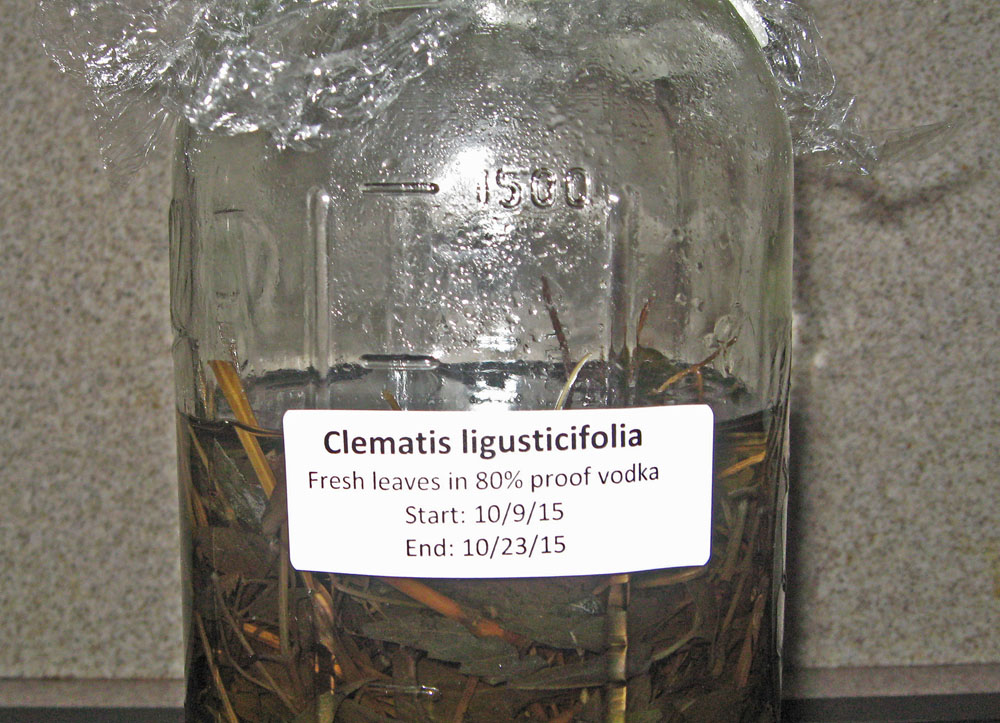 |
| Steeping bottles should be properly labelled |
7. Cover
the extraction jar with a double layer of plastic wrap and screw on the lid. We like to use plastic wrap to insure a good
seal, even when using plastic lids. If
you are using a metal lid, you should always
use plastic wrap.
8. Label
jar with plant name, part used, solvent and date started.
9. Place
in a cool dark place.
10.
Swirl material every day for the first
4-6 days.
11. Let steep for 2 weeks (longer if using
very hard plant materials)
12.
Using the canning funnel, decant the
liquid into a clean jar. We like to place a small sieve inside the canning
funnel to catch the plant materials.
 |
| Decanting a tincture of Heterothica grandiflora |
13. Wearing gloves, squeeze the plant
materials to extract the remaining liquid. Add to the liquid
in the jar.
14. Using the regular funnel, decant the
tincture into the dark-colored glass bottles. Cap and seal.
15. Label with plant name, plant part,
extraction solvent, date started and date bottled.
16. Store in a cool, dry place.
17.
Use as directed.
Note:
amber-colored medicine bottles, caps and dropper caps can be obtained from your
local pharmacist, from Specialty Bottle Supply (http://www.specialtybottle.com/) or from other on-line sources.
 |
| Tinctures from California native plants |
The information in this blog post is not intended to
diagnose, treat, cure, or prevent any disease.
Always see your doctor for any symptoms that are new, unusual, alarming
or bothersome. Be sure to ask your
doctor before beginning any new medication, including herbal medications.
____________
General resources on making tinctures
Resources specific to Southwestern
& California native plants
Garcia, C & Adams, JD. 2012.
Healing with medicinal plants of the west - cultural and
scientific basis for their use, 3rd
ed. Abedus Press, La Crescenta CA. ISBN-10: 097630919X ; ISBN-13:
978-0976309192
Kane, CW. 2011. Medicinal
Plants of the American Southwest (Herbal Medicine of the American Southwest). Lincoln Town Press; Reissue
edition (August 1, 2011). ISBN-10: 0977133370
ISBN-13: 978-0977133376
Largo D, McCarthy DF, Roper M. 2009.
Medicinal Plants Used by Native American Tribes In
Southern California. Malki-Ballena Press. ISBN-10: 0879190000; ISBN-13:
978-0879190002
Moore, M. 1989. Medicinal Plants
of the Desert and Canyon West. Museum of New Mexico Press, Santa
Fe, NM. ISBN-10: 0890131821 ; ISBN-13: 978-0890131824
Moore, M. 1993. Medicinal
Plants of the Pacific West. Museum of New Mexico Press, Santa Fe, NM. ISBN-10: 9780890135396; ISBN-13:
978-0890135396
Moore, M. 2003. Medicinal
Plants of the Mountain West. Museum of New Mexico Press, Santa Fe, NM. ISBN-10: 0890134545; ISBN-13:
978-0890134542
_____________________________________
We
welcome your comments, below. If you
have questions, please e- mail us at: mothernaturesbackyard10@gmail.com


